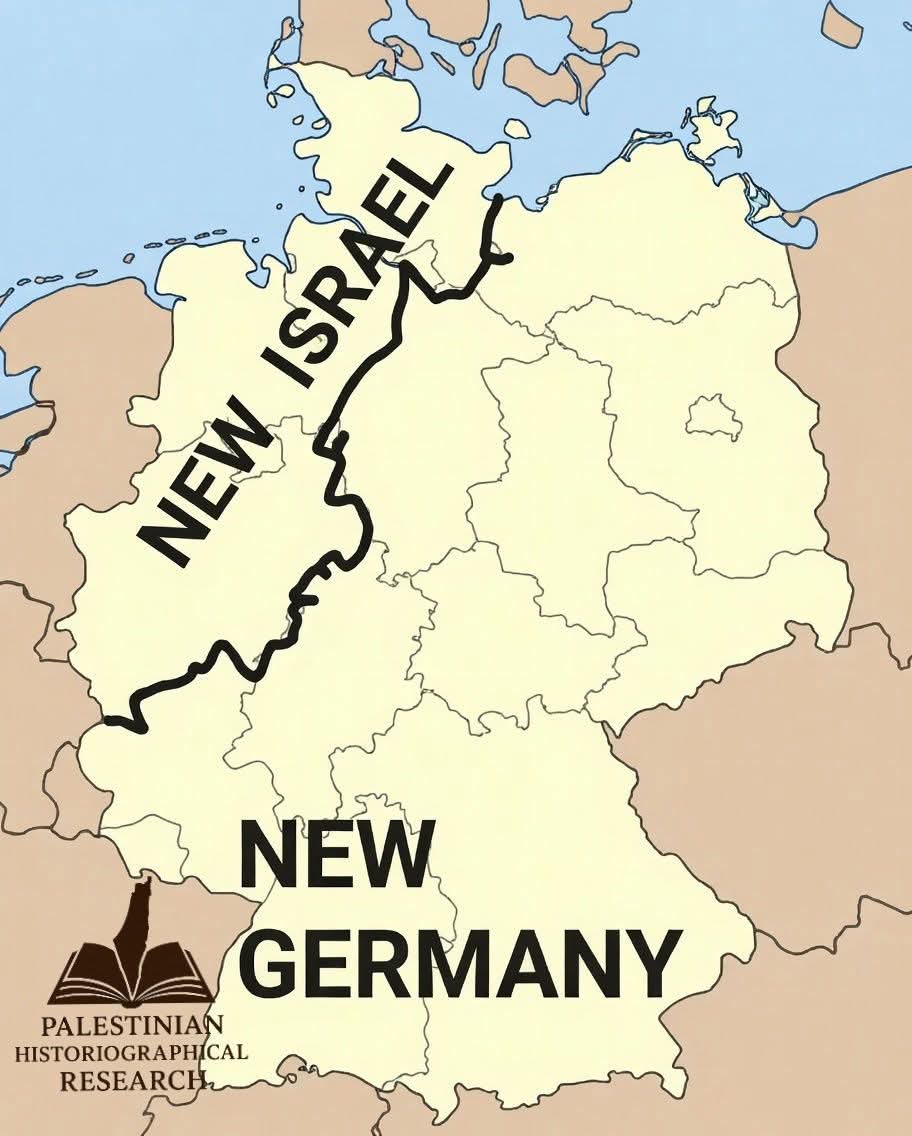
This meme has become very viral again, and although it appears to be a simple joke, it actually poses a profound and provocative question:
Why did the United Nations decide to divide Palestinian territory to create a Jewish state after the Holocaust, rather than allocating territory from Germany, the country directly responsible for the genocide?
From a historical perspective, the population of the region that today comprises Israel and the occupied territories was predominantly Arab, composed mainly of Muslim and Christian communities. In the nineteenth century, Jews represented only about 3–4% of the population, prior to waves of organized Zionist migration (McCarthy, 1990; Schölch, 1985). These migrations were followed by mass expulsions, forced displacements, and massacres in 1948, documented by historians such as Benny Morris (2004).
Ilan Pappé (2006) goes further and characterizes these actions as ethnic cleansing. These measures were driven by the Zionist project, which aimed to secure a significant Jewish majority in a region where Jews had historically been a minority (Ben-Gurion, cited in Masalha, 1992: “Only a state with at least 80% Jews is a viable and stable state”; Morris, 2008; Segev, 2000).
The Balfour Declaration of 1917, often cited as a foundational document, was in reality a colonial letter without binding force or legal authority. It was issued without consulting the Arab population, which at that time constituted nearly 90% of the region’s inhabitants (McCarthy, 1990). This population already had legitimate rights to self-determination and had developed an emerging Palestinian cultural identity long before the collapse of the Ottoman Empire, whereas the Jewish minority consisted of recent immigrants with different cultures and languages.
The idea of a “Greater Israel” is based on a biblical myth rather than historiography. The historical Kingdom of Israel was small, modest, and short-lived, located in a diverse and multiethnic region. At no point did a Jewish hegemony dominate the area (Finkelstein and Silberman, 2001; Dever, 2001).
References
Dever, W. G. (2001). What did the biblical writers know and when did they know it? What archaeology can tell us about the reality of ancient Israel. Eerdmans. Eerdmans Publisher
Finkelstein, I., & Silberman, N. A. (2001). The Bible unearthed: Archaeology’s new vision of ancient Israel and the origin of its sacred texts. Free Press. Archive.org (free access)
Masalha, N. (1992). Expulsion of the Palestinians: The Concept of “Transfer” in Zionist Political Thought, 1882–1948. Institute for Palestine Studies. Institute for Palestine Studies
McCarthy, J. (1990). The population of Palestine: Population history and statistics of the late Ottoman period and the Mandate. Columbia University Press. DOI: 10.7312/mcca93978
Morris, B. (2004). The birth of the Palestinian refugee problem revisited. Cambridge University Press. DOI: 10.1017/CBO9780511816659
Morris, B. (2008). 1948: A history of the first Arab–Israeli war. Yale University Press. DOI: 10.12987/9780300145243
Pappé, I. (2006). The ethnic cleansing of Palestine. Oneworld Publications. Oneworld Publications
Schölch, A. (1985). The Demographic Development of Palestine, 1850–1882. International Journal of Middle East Studies, 17(4), 485–505. DOI: 10.1017/S0020743800029445
Segev, T. (2000). One Palestine, complete: Jews and Arabs under the British Mandate. Metropolitan Books. Macmillan (publisher page)