
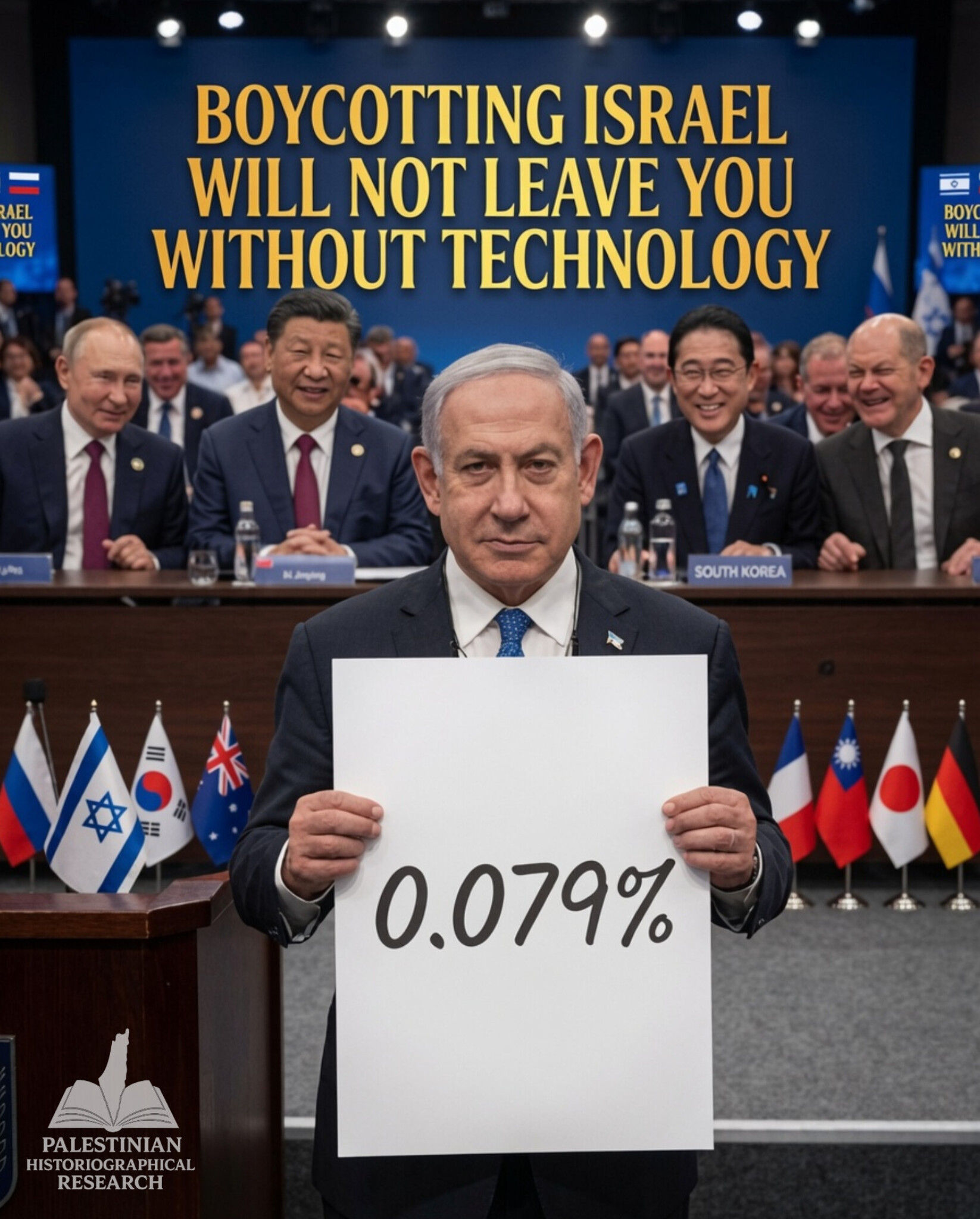
You’ve probably heard Israeli officials repeat the same tired line over and over: “A boycott of Israel will leave you without technology.” It’s delivered with the same desperate confidence as a scam artist insisting their fake Rolex is genuine.
The reality? It’s a massively overstated claim, and the actual data dismantles it completely.
According to the World Bank (2024), Israel’s exports of high-technology goods—items such as R&D-intensive manufactured products like computers, aerospace components, pharmaceuticals, scientific instruments, and electrical machinery—came in at around $19.86 billion in 2024. Compare that to total global merchandise trade, which was roughly $25 trillion (UNCTAD, 2025). That’s a tiny 0.079% of worldwide goods trade. Zero point zero seven nine percent. Countries like China could cover that volume in a matter of weeks without breaking a sweat. The U.S., South Korea, Taiwan, or Germany could step in just as easily.
Even when high-tech services—such as software, cybersecurity, and similar fields—are included, which raise Israel’s total high-tech contribution to about $78 billion according to the Israel Innovation Authority (2025), it still represents only roughly 0.236% of global trade in goods and services combined. That total reached a record $33 trillion in 2024 (UNCTAD, 2025; World Trade Organization, 2024). The world’s phones, laptops, internet infrastructure, cloud platforms, semiconductors, apps, and enterprise software would keep running exactly as they do today—no Israeli code required. No widespread outages, no supply-chain meltdowns. The idea of a “tech apocalypse” is pure exaggeration.
What about the areas where Israel gets the most hype, like cybersecurity? Yes, there are prominent players (Check Point, NSO Group, and companies acquired by Palo Alto Networks), but their footprint remains small on the global stage. Israel held about 0.7% of the worldwide cybersecurity market in 2025 (industry estimates). While the country punches above its weight in funding relative to its size, it doesn’t drive the overall market. Alternatives from the U.S. (CrowdStrike, Palo Alto), India, Eastern Europe, or even China could fill any gaps within months—not years. Many so-called “Israeli breakthroughs” aren’t purely homegrown: they rely heavily on Silicon Valley venture capital, imported global talent, and partnerships with American and European corporations. Strip away that support system, and the shine fades fast.
So why does this myth keep circulating?
It’s classic domestic messaging. Since 1948, Israel has cultivated the story that “the world needs us”—a narrative drilled into education, media, public speeches, and online spaces to reinforce its importance to citizens and international backers. Flashy, high-profile sectors (offensive cyber tools, surveillance tech, military-civilian AI) get amplified to project outsized global indispensability. But they’re specialized niches, not the foundation of modern technology. The international market can—and would—swap them out overnight.
Bottom line: Israel plays a supporting role in the global tech landscape, not a starring one. If its contributions vanished tomorrow, servers wouldn’t crash, updates wouldn’t stop, and cloud services wouldn’t freeze. Life—and innovation—would carry on, just with one less layer of hype.
The emperor has no clothes. A genuine technology boycott would quickly show that the “crown” was made of cardboard all along.
References
- Israel Innovation Authority. (2025). Annual report: The state of high-tech 2025.
- United Nations Conference on Trade and Development (UNCTAD). (2025). Global trade update March 2025.
- World Bank. (2024). High-technology exports (current US$).
- World Trade Organization (WTO). (2024). World trade statistics 2024.