Summary
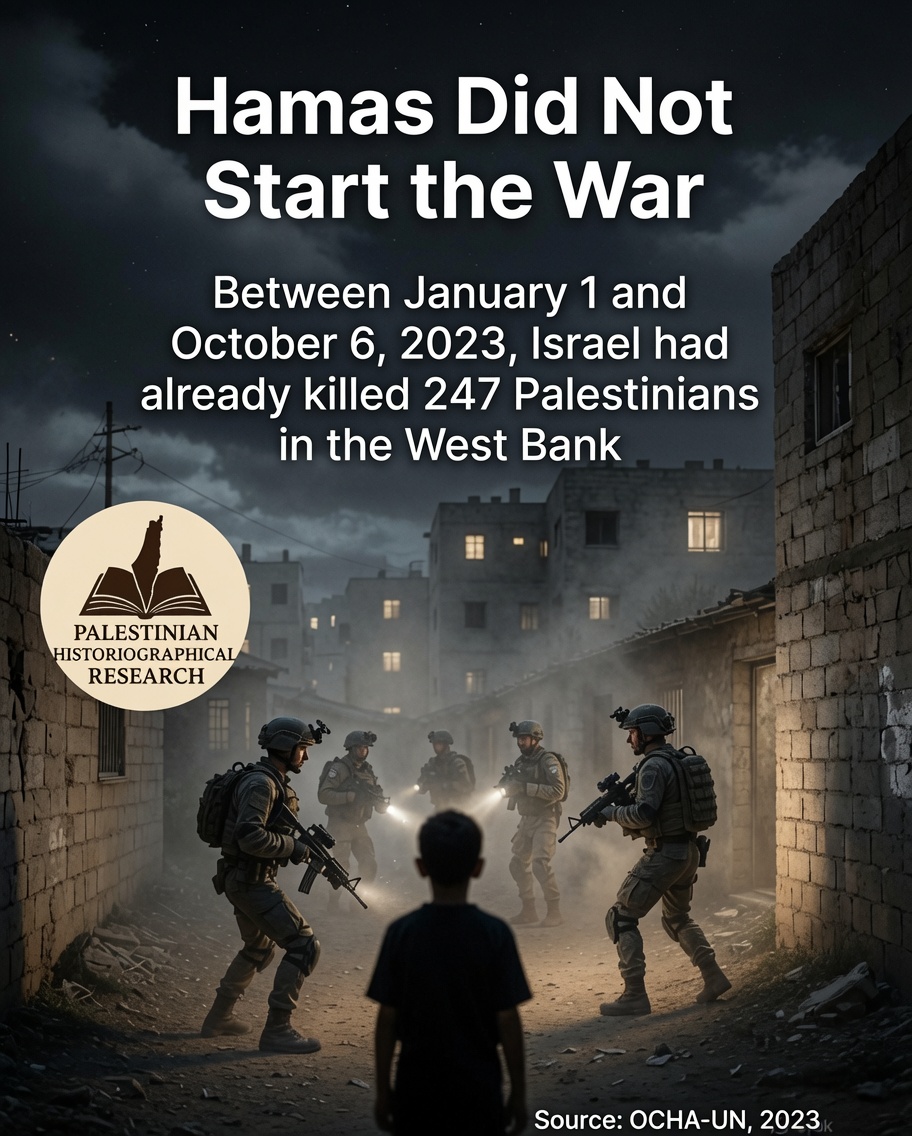
Between January 1 and October 6, 2023, Israel killed 247 Palestinians in the West Bank, according to data from the United Nations Office for the Coordination of Humanitarian Affairs (OCHA, 2023). At the same time, it held 1,264 Palestinians under administrative detention, a practice that allows indefinite imprisonment without charges or trial, based on “secret evidence” inaccessible to the detainee or their lawyer—equivalent to legalized kidnapping.
In the West Bank there is no centralized armed organization like Hamas in Gaza. The victims were mostly civilians: farmers, families, and communities resisting the illegal occupation of their land. This pattern is part of a systematic strategy of occupation described by Israeli historians such as Ilan Pappé and international organizations as apartheid and ethnic cleansing (Pappé, 2006; Human Rights Watch, 2021).
1. A Year of Prior Violence
Between January 1 and October 6, 2023, Israeli forces killed 247 Palestinians in the West Bank during night raids, shootings, and operations in cities such as Nablus, Jenin, and Hebron, as well as in attacks by Israeli settlers. The victims included children, women, and the elderly, many posing no threat whatsoever. Ilan Pappé (2023) describes these operations as “collective punishment” aimed at suppressing any form of resistance, even nonviolent.
Settler violence reached critical levels in 2023, with at least nine Palestinians killed by settlers between January and October (B’Tselem, 2024). These attacks—burning of homes, destruction of olive groves, and physical assaults—often occurred under military protection or complicity. Amnesty International (2024) reports that illegal settlements, backed by the Israeli government, constitute a mechanism of ethnic cleansing to dispossess Palestinians of their land.
In 2023, the government approved more than 12,000 new settlement units in the West Bank, a historic record that intensified confrontations (Peace Now, 2023). Benny Morris (2004) documents how settlements fragment Palestinian territory and undermine the viability of a future Palestinian state.
2. Administrative Detention: Thousands of Prisoners Without Trial
As of October 1, 2023, Israel was holding 1,264 Palestinians in administrative detention, the highest peak in more than 30 years (Human Rights Watch, 2023; HaMoked). Since then, the number has grown exponentially, exceeding 3,500 in recent periods.
This practice allows indefinite detentions renewable every six months, without formal charges or access to evidence. Organizations such as Amnesty International (2012–2023) and the UN (2024) consider it a violation of international law, as it contravenes due process and facilitates torture and ill-treatment. Médecins Sans Frontières (2023) documents inhumane conditions that generate a climate of terror in communities where anyone can be arrested without apparent reason.
3. A Territory Without Centralized Armed Groups
Unlike Gaza, the West Bank has no centralized armed organization like Hamas. Israeli raids targeted residential neighborhoods, refugee camps, and unarmed rural communities. Human Rights Watch (2024) describes the situation as a “system of apartheid” with movement restrictions, home demolitions, and everyday state violence.
Michael Lynk (2022), UN Special Rapporteur, stated that the occupation has crossed the threshold into an apartheid regime due to its permanent and discriminatory character. Pappé (2023) notes that the operations seek to consolidate territorial control and suppress all resistance, armed or peaceful.
4. Impunity and Prelude to Disaster
The international community has failed to address the escalation of violence in the West Bank. Amnesty International (2024) criticizes the inaction of multilateral bodies such as the UN, which have not imposed effective sanctions on Israel for its violations of international law. This impunity has allowed policies of occupation, forced displacement, and repression to continue without consequences. Noam Chomsky (2023) argues that the complicity of Western powers, especially the United States, has been crucial in sustaining this status quo.
The violence in the West Bank before October 7, 2023 was not a reaction to Hamas, but the continuation of a prolonged war of occupation against a civilian population. This context of sustained suffering and lack of international justice created the conditions for the subsequent escalation. As Norman Finkelstein (2018) warns, “the systematic oppression of a people can only engender resistance in all its forms.”
References
- Addameer. (2023). Annual report 2023: Palestinian prisoners under occupation.
- Amnesty International. (2012). Israel: The injustice and secrecy surrounding administrative detention.
- Amnesty International. (2023). Israel/OPT: Horrifying cases of torture and degrading treatment of Palestinian detainees amid spike in arbitrary arrests.
- Amnesty International. (2024). Israel and the Occupied Palestinian Territory: 2023 report.
- B’Tselem. (2024). Statistics on fatalities.
- Chomsky, N. (2015). On Palestine. Haymarket Books.
- Chomsky, N. (2023). The moral bankruptcy of Western support for Israel. Jacobin.
- Finkelstein, N. G. (2018). Gaza: An inquest into its martyrdom. University of California Press.
- HaMoked. (2025). Prisoners charts.
- Human Rights Watch. (2021). A threshold crossed: Israeli authorities and the crimes of apartheid and persecution.
- Human Rights Watch. (2023). Unprecedented repression demands unprecedented response.
- Human Rights Watch. (2024). World report 2024: Israel/Palestine.
- Lynk, M. (2022). Report of the Special Rapporteur on the situation of human rights in the Palestinian territories occupied since 1967. United Nations General Assembly.
- Médecins Sans Frontières. (2023). Palestinians in the West Bank: 2023 was the deadliest year on record.
- Médecins Sans Frontières. (2023). West Bank: MSF condemns attacks on civilians and healthcare workers.
- Morris, B. (2004). The birth of the Palestinian refugee problem revisited. Cambridge University Press.
- United Nations Office for the Coordination of Humanitarian Affairs. (2023). Data on casualties.
- United Nations Office of the High Commissioner for Human Rights. (2024). UN report: Palestinian detainees held arbitrarily and secretly, subjected to widespread torture and ill-treatment.
- Pappé, I. (2006). The ethnic cleansing of Palestine. Oneworld Publications.
- Pappé, I. (2023). The ongoing Nakba: Israel’s policies of displacement and control. Middle East Eye.
- Peace Now. (2023). Settlement expansion report 2023.