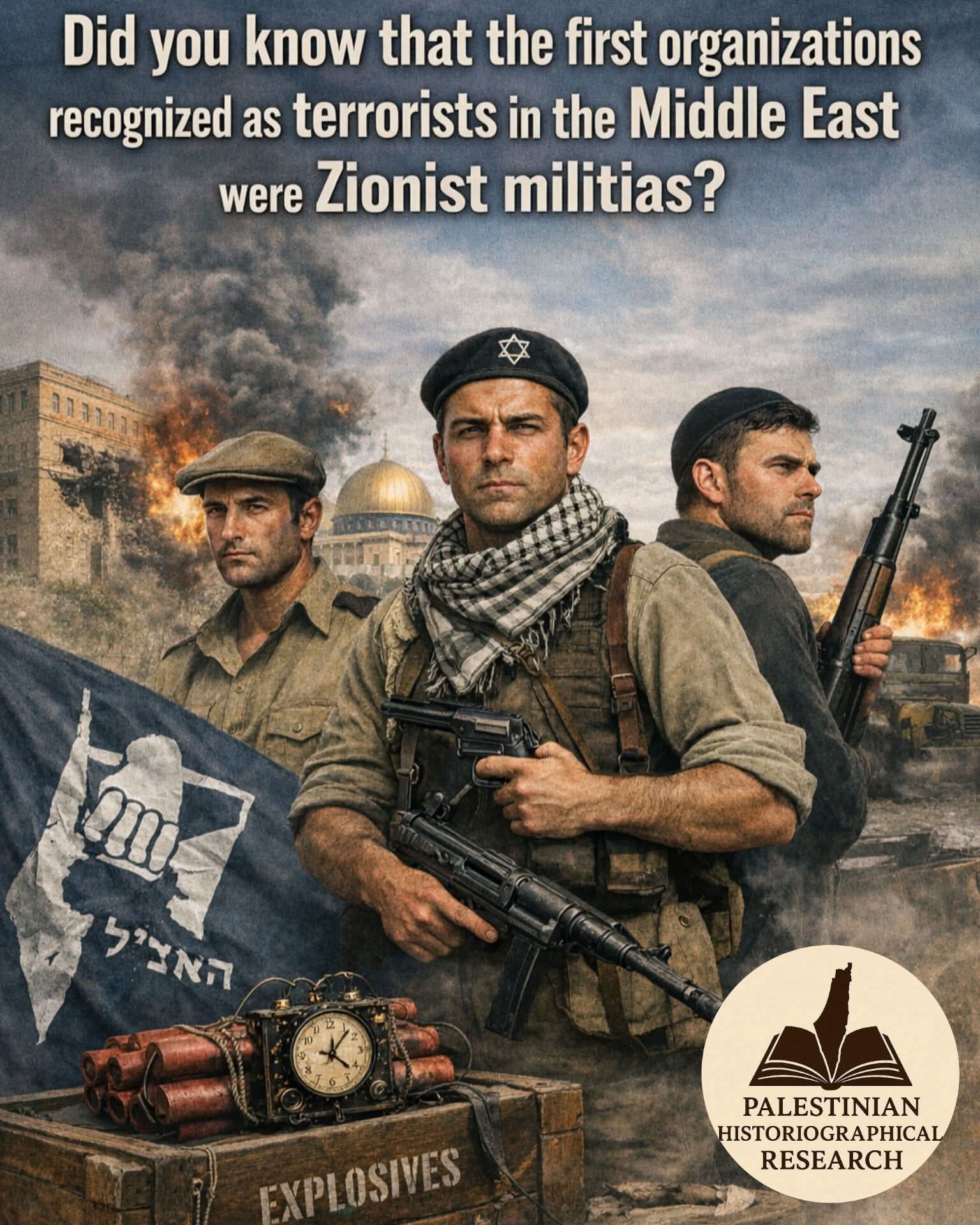
Contrary to the prevalent Western narrative, which frequently links terrorism in the Middle East solely to Islamist groups, this type of organized violence initially arose through Zionist militias that carried out bombings, terror campaigns, and systematic assaults in Palestine long before 1948. These militias relied on terror as a primary instrument to push for the creation of a Jewish state, openly defying British rule and targeting both civilians and officials. Groups such as Irgun Zvai Leumi (Etzel) and Lohamei Herut Israel (Lehi) were unambiguously terrorist organizations, identified as such by British authorities and corroborated by historians through documentary evidence documenting their tactics, including bombings, targeted killings, and sabotage. These actions represent the earliest documented instances of organized political terrorism in the modern Middle East (Bell, 1977; Hoffman, 1986; Zvada & Lach, 2022).
1. Irgun (Etzel): Structure, Methods, and Cross-Border Violence
Irgun Zvai Leumi was established in 1931 as a dissident faction of Revisionist Zionism, explicitly intending to employ terrorist tactics against British authorities and any perceived obstacles. J. Bowyer Bell’s research meticulously chronicles Irgun’s operations, portraying it as a covert entity executing bombings, sabotage, and deliberate strikes against governmental institutions and civilian populations—actions that squarely align with definitions of urban terrorism (Bell, 1977). These methods not only weakened British authority in Palestine but also left a lasting legacy of violence that shaped subsequent conflicts.
Historical accounts confirm that Irgun conducted bombing attacks in public spaces and against British security positions throughout the 1930s and 1940s, causing multiple civilian and official casualties. Such operations cemented its standing as a terrorist organization both domestically and abroad. In response to measures like the 1939 British White Paper, Irgun escalated its terror campaigns to coerce a British withdrawal from the Mandate, demonstrating a calculated deployment of violence to achieve political ends (Hoffman, 1986; Zvada & Lach, 2022).
2. Lehi (Stern Gang): Extremism and Targeted Killings
Lehi, or the Stern Gang, emerged in 1940 as a splinter from Irgun under Avraham Stern’s leadership. Unlike Irgun, Lehi rejected any cooperation with British forces, even during World War II, and identified them as the foremost enemy in the struggle for a Jewish state. Scholars classify Lehi as among the most radical terrorist organizations of the period, accountable for high-profile political assassinations, including the killing of Lord Moyne in Cairo in 1944, illustrating its commitment to calculated violence (Hoffman, 1986; Zvada & Lach, 2022).
Lehi’s approach centered on deliberate terror operations against colonial authorities and prominent figures, aligning precisely with academic definitions of political terrorism: the systematic employment of violence against non-combatants to fulfill ideological aims (Bell, 1977; Hoffman, 1986). This extremism not only intensified the conflict but also established templates for terrorist practices in the region.
3. Haganah and the Multifaceted Nature of Violence
Although Haganah, the largest Zionist paramilitary organization, initially portrayed itself as defensive against assaults on Jewish communities, historical documentation reveals its involvement in offensive operations coordinated with Irgun and Lehi, especially in the late 1940s when violence escalated in the Mandate. A constructivist analysis underscores how Haganah, together with Irgun and Lehi, actively contributed to patterns of organized political violence, challenging its purely defensive portrayal and highlighting its participation in Israel’s formation through methods that bordered on terrorism (Çelebi, 2025; Zvada & Lach, 2022).
4. Recognized as Terrorist Organizations
The labeling of Irgun and Lehi as terrorist groups was not a later reinterpretation; during the British Mandate, colonial authorities explicitly classified them as such and implemented counterterrorism measures to dismantle them. Bruce R. Hoffman’s research examines how these groups systematically subverted British authority via assassinations, sabotage, and attacks on civilians and officials, satisfying academic criteria for terrorism (Hoffman, 1986). This designation exposes the selective narratives that omit these Zionist roots of Middle Eastern terrorism, favoring biased historical perspectives.
5. From Militants to Israeli Prime Ministers
One of the most controversial aspects of Irgun and Lehi’s history is that several of their key leaders, directly responsible for assassinations, bombings, and acts of sabotage, later ascended to the highest positions in the Israeli government after independence. Menachem Begin, head of Irgun, orchestrated operations including bombings of British administrative offices and targeted killings of officials between 1944 and 1948 (Bell, 1977; Hoffman, 1986). Among his most infamous deeds was the 1946 bombing of the King David Hotel in Jerusalem, which killed 91 individuals, including civilians, and wounded over 45 (Bell, 1977). Despite this record, Begin was elected Prime Minister in 1977, almost three decades later, serving as a clear example of how leaders once labeled terrorists could integrate into state power.
Yitzhak Shamir, formerly part of Lehi, is another notable case. He participated in political assassinations from 1942 to 1947, targeting British officials and settlers deemed hostile to the Zionist agenda (Hoffman, 1986; Zvada & Lach, 2022). Shamir was involved in planning and executing Lord Moyne’s assassination in Cairo in 1944, a prominent act intended to intimidate British authorities and advance the cause of Jewish independence (Hoffman, 1986). He later served two terms as Prime Minister, from 1983–1984 and 1986–1992, exemplifying the paradox of an individual with a proven history of systematic political violence ascending to national leadership.
These examples indicate that the transition from armed militants to central political figures was not an anomaly but a feature of Israel’s state formation. The reintegration of Begin, Shamir, and other former radicals raises challenging questions about the legitimacy of their methods, historical reinterpretation of their actions, and official political memory. It further demonstrates how organized violence can be normalized—or even glorified—within a national context depending on the political objectives achieved (Bell, 1977; Hoffman, 1986; Zvada & Lach, 2022).
Conclusion
Historical analysis confirms that Irgun and Lehi were indisputably the first terrorist organizations in the Middle East, employing structured political violence for strategic objectives during the British Mandate of Palestine. Scholarly literature, documenting their leaders, tactics, and consequences, firmly positions them within the history of 20th-century organized terrorism, preceding groups that arose after Israel’s founding and challenging narratives that downplay their violent legacy (Bell, 1977; Hoffman, 1986; Zvada & Lach, 2022; Çelebi, 2025).
References
Bell, J. B. (1977). Terror out of Zion: Irgun Zvai Leumi, Lehi, and the Palestine Underground, 1929–1949. St. Martin’s Press. [Available on Internet Archive]
Çelebi, E. (2025). A constructivist approach to the roles of Haganah, Irgun, and Lehi in the establishment of Israel. Terörizm ve Güvenlik Araştırmaları Dergisi, 2(1), 1–14. [Access the article] | [ResearchGate]
Hoffman, B. R. (1986). Jewish terrorist activities and the British government in Palestine, 1939–1947 [Unpublished doctoral dissertation]. University of Oxford. [Access the thesis at Oxford University Research Archive]
Zvada, Ľ., & Lach, J. (2022). Bloody years of the Jewish insurgency in British Mandatory Palestine 1939–1948: From the White Paper to the State of Israel. Vojenské rozhledy, 31(3), 121–136. [PDF on ResearchGate]