Dismantling a Narrative
For more than a century, Zionist historiography and much of Western common sense have repeated the same image: nineteenth-century Palestine as an empty, backward, stagnant land, a wasteland of swamps and deserts awaiting “redemption” through European colonization.
The Zionist slogan “a land without a people for a people without a land” was not a description, but an ideological construction serving a political project: if the land was empty, there was no one to dispossess of their right to self-determination.
This image is decisively contradicted by sources of different origins and methodologies. On one hand, Ottoman population censuses and registers (sicill-i nüfus) and the administrative yearbooks (salname) of the vilayets and sanjaks. On the other, the customs records of the Palestinian ports. And, in addition, British and French consular reports of the era, compiled independently by Western economic historians.
These are sources that do not depend on one another, and yet they converge on the same conclusion.
A Growing Population, Not a Demographic Void
Between 1850 and 1882, Palestine’s population grew by approximately 38%.
This figure does not rest on a single source. The Ottoman population records were worked on independently by Justin McCarthy (1990), based on official Ottoman government statistics and those of the British Mandate.
Also by Kemal Karpat (1985), whose systematic study of nineteenth-century Ottoman censuses—including the general census of 1881-82, coinciding with the period examined here—constitutes the reference demographic base for the entire late Ottoman Empire.
These authors worked with different documentary corpora and independently of one another. And yet they converge on the same underlying conclusion: Palestine’s population was growing steadily.
The growth is explained by endogenous causes—high birth rates and declining mortality—a pattern documented by McCarthy (1990), who explicitly examined the hypotheses of economic migration, refugees, and unregistered immigration and found no evidence that they carried significant demographic weight.
Schölch (1985), in an independent study specifically devoted to the demography of the sanjaks of Jerusalem, Nablus, and Acre between 1850 and 1882, reconstructs the same sustained growth—from approximately 350,000 to 470,000 inhabitants over those thirty-two years—and situates it within a context of improved security, agricultural expansion, and better sanitary conditions.
Palestine’s growth was not, then, the result of an external influx that came to “fill the void.” It was the organic growth of a population that was already there, documented in the very administrative records of the Empire it belonged to—under the sanjaks of Jerusalem, Nablus, and Acre, the Ottoman administrative division of the region.
The Contrast the Colonial Narrative Prefers to Ignore
It is worth placing this trajectory alongside that of other peripheries subjected to European colonial rule in the same period, because the contrast is revealing.
Ireland’s population, a de facto colony of the British Empire, fell from 8.1 million inhabitants in 1841 to 5.1 million in 1881—a decline of nearly 37%—as a direct consequence of British policies that prioritized revenue from Irish food exports over the lives of the local population during the Great Famine (Central Statistics Office [Ireland], n.d.).
Algeria under French rule suffered an even more brutal demographic collapse among its indigenous population. It was the result of military conquest, massacres, scorched-earth tactics, famine, and disease, with estimates of up to one million deaths (Kiernan, 2007).
Against these processes of colonial demographic destruction, Palestine—under Ottoman, not European, administration—showed the opposite trajectory: a growing population, declining infant mortality, and improving economic conditions.
The contrast is not coincidental: where European colonial power installed itself directly, the native population collapsed. Where it did not, the population thrived.
Agricultural Exports: An Economy Integrated into the World
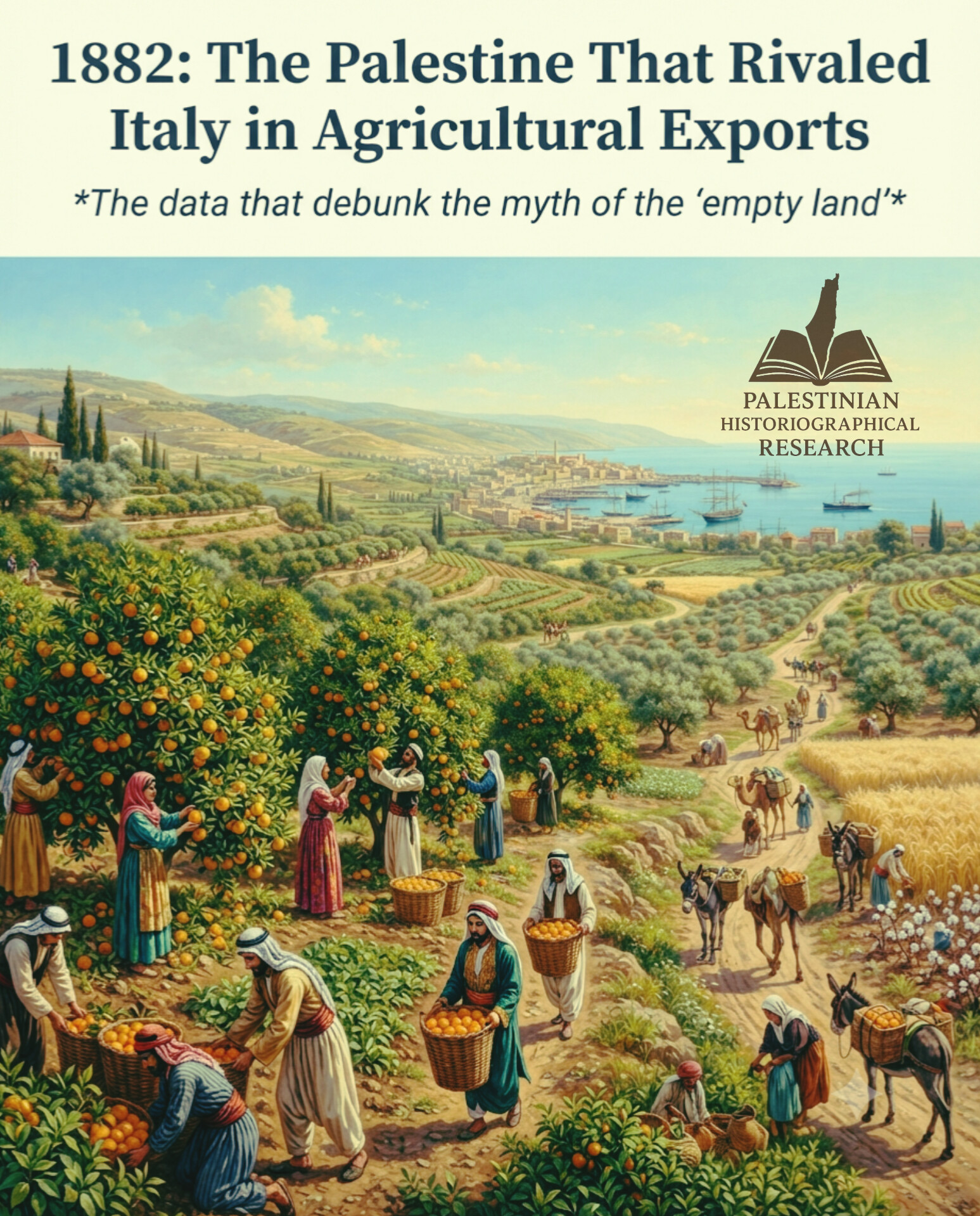
The engine of this growing economy was the agricultural sector and its derivatives.
Since the Ottoman Empire did not keep a national account of exports for Palestine, the figure must be reconstructed from the customs records of its three ports: Jaffa, Haifa, and Acre. These records place combined agricultural exports at around two to two and a half million dollars annually in the early 1880s.
Adding a conservative estimate to compensate for the missing documentation from Haifa and Acre regarding wool, cotton, and olive oil, the resulting figure amounts to between $4.80 and $6.00 per person (Schölch, 1993).
As with the demographic data, these figures do not depend on a single source. Schölch (1993) reconstructs them from Ottoman and European administrative and consular sources focused specifically on Palestine.
Issawi (1988), working independently, compiled and systematized British and French consular reports on the trade of Jaffa and the region for the same period, as part of his documentary economic history of the entire Fertile Crescent.
Owen (1981), for his part, reconstructed aggregate series of Ottoman foreign trade at the regional scale that confirm the same trend of Palestinian commercial expansion.
These are three distinct documentary corpora—Ottoman records, European consular reports, and regional macroeconomic series—that converge on the same diagnosis: an export economy in sustained growth, not a statistical anomaly or the artifact of a single reconstruction.
Palestine Against the Mediterranean: The Numbers Don’t Lie
Compared to other agrarian economies of the Mediterranean basin and North Africa, Palestine’s position alone refutes the narrative of backwardness.
Italy’s agricultural exports per capita ranged between $6.30 and $6.65 (Federico et al., 2011), practically on par with Palestine.
Morocco lagged far behind, at around $1.00 per person, and Libya reached barely $0.03 (Federico & Tena-Junguito, 2019).
Egypt, thanks to its cotton trade, surpassed Palestine with figures between $7.00 and $8.00 per capita (Federico & Tena-Junguito, 2019). But the gap between the two was far smaller than the one separating Palestine from Morocco or Libya.
Palestine performed well above the regional average. By 1882, it was no longer a subsistence economy exporting occasional surpluses: it was a commercial sector in expansion, deliberately oriented toward the international market.
The “empty territory” of Zionist mythology was, in fact, one of the most dynamic agrarian economies in its immediate surroundings.
From Prosperity to Dispossession: The Problem of 1917
This trajectory of autonomous growth was interrupted by decisions made thousands of miles away.
In 1915-1916, through the Hussein-McMahon correspondence, the British government promised Arab leaders self-government and independence in exchange for joining them in their war against the Ottoman Empire, explicitly invoking the principle of self-determination for Arab peoples.
Two years later, the same British government issued the Balfour Declaration (1917), committing to favor the establishment in Palestine of a “national home for the Jewish people”—a promise made not to the affected people, but in a letter addressed to a British lord, Walter Rothschild.
The contradiction is documentable, not merely moral: the same state that a year earlier had invoked self-determination as a principle to justify support for Arab independence abandoned it in 1917.
It abandoned it with respect to a territory whose Jewish population—according to the convergence of the demographic sources already cited (McCarthy, 1990; Karpat, 1985)—did not exceed 10% of the total by the end of the Ottoman period, against an Arab majority, both Muslim and Christian, of around 90%.
The clause in the Declaration referring to the protection of the “civil and religious rights” of the “existing non-Jewish communities in Palestine”—without naming them as Arabs or Palestinians—does not resolve this contradiction. It is evidence that the text itself recognized it as a problem, without going so far as to apply the very principle that was being granted to other populations under Ottoman rule in the same diplomatic correspondence of those years.
References
- Central Statistics Office (Ireland). (n.d.). Statistical yearbook of Ireland: Population of Ireland, 1841–1926. CSO. https://www.cso.ie/en/census/censusreports1821-2006/
- Federico, G., Natoli, S., Tattara, G., & Vasta, M. (2011). Il commercio estero italiano, 1862–1950 (Collana Storica della Banca d’Italia, Statistiche Storiche, Vol. 4). Editori Laterza. https://www.bancaditalia.it/pubblicazioni/collana-storica/statistiche/statistiche-04/index.html
- Federico, G., & Tena-Junguito, A. (2019). World trade, 1800–1938: A new synthesis. Revista de Historia Económica – Journal of Iberian and Latin American Economic History, 37(1), 9–41. https://doi.org/10.1017/S0212610918000216
- Issawi, C. (1988). The Fertile Crescent, 1800–1914: A documentary economic history. Oxford University Press.
- Karpat, K. H. (1985). Ottoman population, 1830–1914: Demographic and social characteristics. University of Wisconsin Press.
- Kiernan, B. (2007). Blood and soil: A world history of genocide and extermination from Sparta to Darfur. Yale University Press.
- McCarthy, J. (1990). The population of Palestine: Population history and statistics of the late Ottoman period and the Mandate. Columbia University Press.
- Owen, R. (1981). The Middle East in the world economy, 1800–1914. Methuen.
- Schölch, A. (1985). The demographic development of Palestine, 1850–1882. International Journal of Middle East Studies, 17(4), 485–505. https://doi.org/10.1017/S0020743800029445
- Schölch, A. (1993). Palestine in transformation, 1856–1882: Studies in social, economic and political development. Institute for Palestine Studies.
Methodological note: both the demographic and commercial figures presented in this article are supported by convergent independent research, carried out with distinct documentary corpora and methodologies—Ottoman administrative and census records, European consular reports, and aggregate reconstructions of foreign trade—that arrive at the same general conclusions (McCarthy, 1990; Schölch, 1985, 1993; Karpat, 1985; Issawi, 1988; Owen, 1981).