Abstract
This article examines the origin and development of the Palestinian citrus industry, dismantling the narrative that presents it as an exclusive achievement of the Zionist project. Through data cross-referenced with specialized academic sources, it demonstrates that the industry was created and dominated by Palestinian farmers and merchants for most of the period between the mid-nineteenth century and 1948. The waves of Jewish immigration (aliyot) played a secondary role well into the twentieth century. From the 1930s onward, the massive influx of German Jewish capital following Nazi persecution drove a significant expansion of the Jewish citrus sector, which progressively increased its share of the industry until the outbreak of the Second World War and the closure of European markets interrupted that trend. Israeli hegemony in citrus exports was consolidated only after the ethnic cleansing of 1948, which expelled the Palestinian population and transferred their productive infrastructure to the new State. The subsequent Zionist narrative systematically silenced that Arab origin, rewriting history to legitimize territorial and economic appropriation.
Introduction
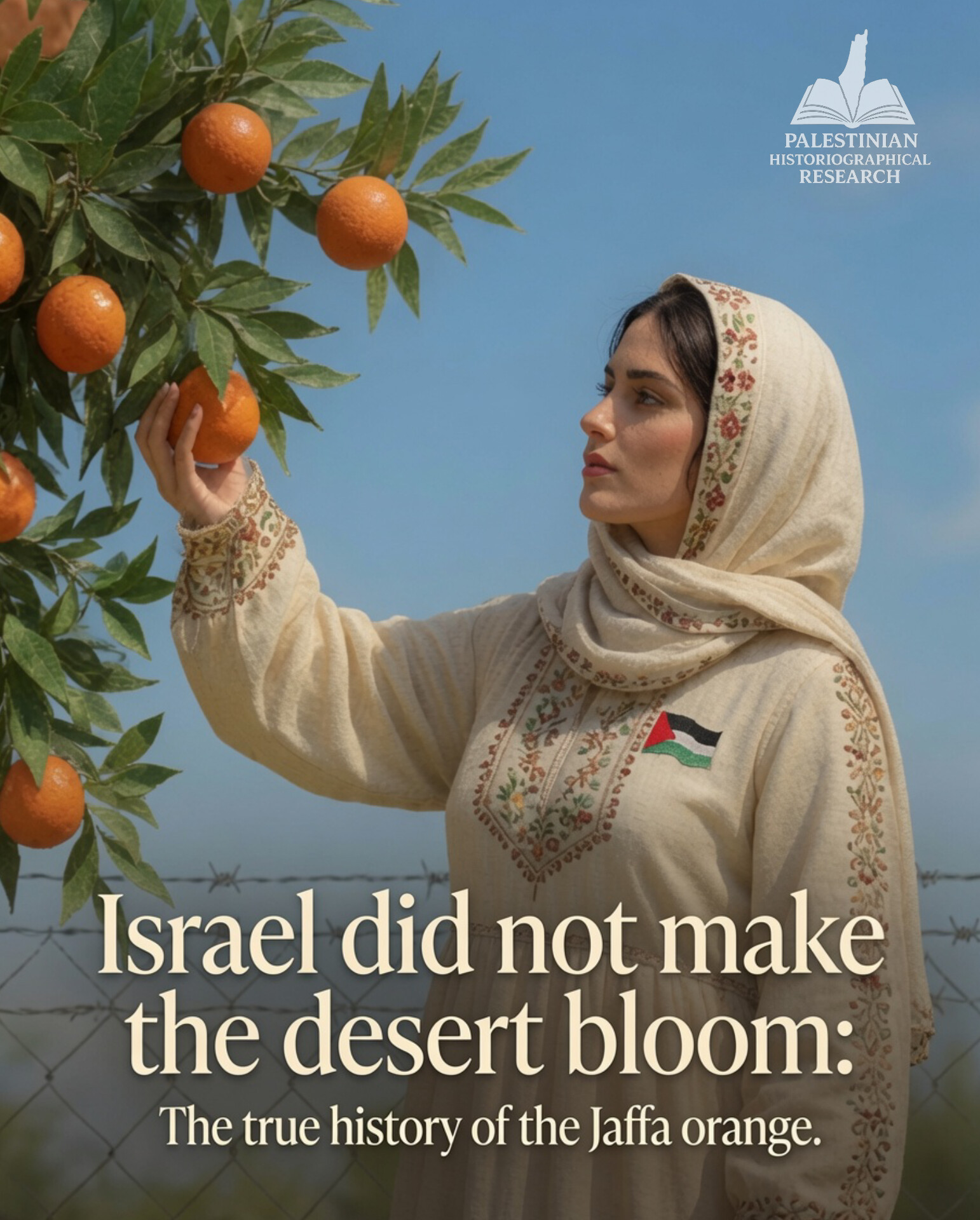
The Zionist narrative presents the Jaffa orange as an emblem of Jewish ingenuity in Palestine, a supposed “miracle” that transformed barren land into thriving orchards. Yet this version conceals the Palestinian origin of the citrus industry and the process by which it was appropriated following the mass expulsion of 1948. This article recovers the Arab predominance during most of the period, nuances the role of the aliyot — secondary for decades and only transformed into a growing trend by very specific historical circumstances — and analyzes the subsequent appropriation and narrative erasure that followed (Pappé, 2006; Khalidi, 1997; Kabha & Karlinsky, 2021).
1. Arab Consolidation of Cultivation (1850–1914)
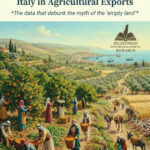
During the second half of the nineteenth century, the peasants of the coastal plain between Yafa (Jaffa) and Ramla transformed the old Ottoman orchards — characterized by traditional subsistence crops — into an intensively irrigated capitalist agriculture, driven by integration into the Ottoman and European global market.
There they perfected the sweet, thick-skinned variety known as “shamouti,” marketed internationally as the Jaffa orange and selected for its resistance to maritime transport and its superior flavor (Schölch, 1986). Unlike the rest of the Ottoman Empire, where production chains were fragmented and controlled by foreign intermediaries, in Palestine the entire productive chain — from seedbeds and nurseries to irrigation wells, distribution channels, packing plants, and export companies — remained in the hands of Muslim and Christian Palestinian families rooted in cities such as Yafa, Lydda, and Ramla (Khalidi, 1997; Campos, 2011).
This consolidation was no accident: Palestinian investors such as the Dajani family and the Abdulhadis financed the expansion of the orchards, introducing grafting and crop rotation techniques that raised yields. The industry was, in every link of its chain, a Palestinian creation.
By the late nineteenth century, Palestine was already systematically exporting citrus to British and Mediterranean ports. By 1913–14, oranges accounted for around 40% of the total value of exports from the port of Jaffa and all of Ottoman Palestine, with production predominantly in Arab hands (Schölch, 1993; Kabha & Karlinsky, 2021).
2. Templar Intervention and the Early Aliyot: Secondary Actors
Between 1870 and 1909, German Templar settlers introduced technological innovations such as mechanical juice presses and standardized wooden packing crates that reduced damage during transatlantic transport. These contributions, however, did not alter land ownership or economic control: the Templars leased Palestinian facilities and operated as a peripheral minority, with a share that did not exceed 2–3% of total citrus production (Friedrichs, 2019).
The aliyot began with the First Aliyah (1882–1903), composed primarily of Russian Jews fleeing pogroms, and the Second Aliyah (1904–1914), influenced by socialist ideals. In the citrus sector, their role was marginal: they purchased isolated farms and founded settlements such as Petah Tikva and Rishon LeZion, initially focused on vineyards and cereals.
Their participation in citrus exports remained very limited until 1914, constrained by a lack of irrigation experience and dependence on Palestinian Arab labor, which constituted the vast majority of workers in Jewish-owned orchards (Metzer, 1998). Until the First World War, the Jewish sector exported far smaller volumes than the Arab sector (Seikaly, 2016).
3. The British Mandate: Arab Predominance, Zionist Investment, and the Transformation of the Industry (1920–1947)
With the British occupation following the Ottoman defeat in 1918, European markets expanded through preferential trade agreements. Jewish cooperatives — such as the Pardess Union and the Histadrut Citrus Committee — extended irrigation areas through mechanical pumps and land purchases, benefiting from British policies that favored Zionist immigration.
For most of the Mandate period, the Palestinian-Arab citrus industry surpassed the Jewish sector both in physical area and in export volume (Kabha & Karlinsky, 2021). In 1920, the area of Jewish-owned citrus groves represented approximately 35% of the total (Karlinsky, 2000).
From 1933 onward, however, the dynamics changed substantially. The Fifth Aliyah (1933–1939) — driven by the massive influx of German Jewish capital following Nazi persecution — financed an unprecedented citrus expansion. Investment in the Jewish sector grew at an accelerated pace, allowing Jewish-owned planted area and harvests to progressively catch up with and surpass Palestinian ones over the course of the decade. By 1940, the area of Jewish-owned citrus groves had come to represent approximately 52% of the total — some 155,000 dunams out of 300,000 (Karlinsky, 2000).
It is important to stress that this advantage had specific structural causes and did not reflect a permanent agronomic superiority. First, trees newly planted in the 1930s took between five and eight years to reach full commercial production, meaning that growth in planted area did not immediately translate into an equivalent increase in exported output. Second, between 1935 and 1939 the citrus sector as a whole experienced a severe profitability crisis due to overproduction and falling prices in European markets (Karlinsky, 2000). Third, the Arab Revolt (1936–1939) disrupted exports and affected investment across the entire sector.
During the Second World War (1939–1945), citrus exports collapsed for both sectors: from approximately 15 million crates in 1938–39 to just 170,000 in 1940–41, recovering to only 2.75 million in 1944–45 (Metzer, 1998). The closure of European markets interrupted the expansionary trend of the Jewish sector, and the total area of Palestinian-owned orchards once again surpassed that of Jewish-owned groves by the end of the conflict (Kabha & Karlinsky, 2021).
Toward the end of the Mandate, Arabs retained ownership of the majority of the orchards and control of the leading export houses — Tuqan, Shuqayri, Khalil, and Rock — which managed the greater part of exports from Jaffa (Seikaly, 2016; Village Statistics, 1945).
It should also be noted that official Mandate statistics tended to capture Jewish sector production more accurately — being more centralized in cooperatives with formal records — than Arab production, which was dispersed among thousands of small producers with informal commercial channels. This means that the official figures of the period likely underestimate the real weight of Palestinian production (Metzer, 1998; Kabha & Karlinsky, 2021).
4. 1948: Expulsion, Expropriation, and Quantitative Shift
During the Zionist military operations of spring 1948 — chief among them Operation Hametz against Jaffa, as well as operations targeting Lydda, Ramla, and other towns of the coastal plain — more than 80% of the Arab inhabitants of the Yafa region were displaced through terror tactics, bombardment, and massacres. The city of Jaffa, home to approximately 70,000 inhabitants before 1948, was practically emptied within a matter of weeks. This process was documented as part of a planned ethnic cleansing (Pappé, 2006; Morris, 2004).
The citrus orchards abandoned by the expelled population were declared “absentee property” and transferred to the State of Israel through the Absentees’ Property Law (1950), which legalized expropriation without compensation. According to the records of the Custodian of Absentee Property, a substantial portion of the citrus orchards of the coastal plain — including mature groves, irrigation systems, packing plants, and port networks built by generations of Palestinian farmers and merchants — came under this regime of forced transfer (Fischbach, 2003, Ch. 1).
The result was immediate: within a few years, Israeli production came to dominate citrus exports, with millions of crates exported under the “Jaffa” brand. But that outcome was based on the appropriation of others’ infrastructure, not on any prior agronomic superiority. Custodian documents reveal that the vast majority of the transferred orchards were registered Arab properties, many of which were assigned to kibbutzim and agricultural enterprises without significant initial investment on their part (Fischbach, 2003).
5. Erasure of the Narrative
From the 1950s onward, Israeli textbooks systematically omitted the Palestinian origin of the citrus industry, presenting the orange as a symbol of Jewish creativity on ancestral land and attributing the citrus boom to Zionist pioneers. Peled-Elhanan’s (2012) analysis documents that Arab contributions to the agriculture and economy of Palestine were systematically marginalized or absent from Israeli educational materials until the 2000s.
The international advertising campaign of the Jaffa brand, promoted by the Israel Citrus Marketing Board from the mid-twentieth century onward, presented the orange as a symbol of the State of Israel while concealing that Jaffa had been a predominantly Arab-Palestinian city until 1948, whose tens of thousands of inhabitants had been expelled. By 1976, the Jaffa brand was recognized as the second most widely known commercial trademark among the European public, second only to Coca-Cola.
This rewriting spread throughout the Western media, where United Nations reports on refugees and expropriations were systematically ignored, perpetuating the myth of “a land without a people for a people without a land.” Recovering the true history of the Jaffa orange is part of a broader effort to resist the cultural erasure that legitimizes the ongoing occupation (Peled-Elhanan, 2012; Khalidi, 1997; Kabha & Karlinsky, 2021).
Conclusion
The Jaffa orange is not an icon of Zionist ingenuity: it is the product of generations of Arab-Palestinian agricultural knowledge, refined by farmers and merchants who built a world-class export industry. The waves of Jewish immigration played a secondary role for decades. From the 1930s onward, an extraordinary injection of German capital — not structural agronomic superiority — drove an accelerated expansion of the Jewish sector that progressively increased its share of the industry, a trend that the outbreak of the Second World War and the collapse of European markets interrupted. Israeli definitive hegemony in exports was consolidated only after the ethnic cleansing of 1948, which expelled hundreds of thousands of Palestinians and transferred to the new State the productive infrastructure those generations had built. The subsequent Israeli narrative silenced that origin through the systematic erasure of Arab memory in educational and media accounts. Recovering this history is to resist the appropriation of Palestinian identity and to affirm the continuity of a people inseparably bound to their land and their fruit.
References
Campos, M. (2011). Ottoman brothers: Muslims, Christians, and Jews in early twentieth-century Palestine. Stanford University Press.
Fischbach, M. R. (2003). Records of dispossession: Palestinian refugee property and the Arab-Israeli conflict. Columbia University Press.
Friedrichs, N. (2019). German Templers in Palestine: A colonial experiment. Journal of Palestine Studies, 48(3), 7–24.
Government of Palestine. (1945). Village statistics 1945: A classification of land and area ownership in Palestine. Government Printer.
Kabha, M., & Karlinsky, N. (2021). The lost orchard: The Palestinian-Arab citrus industry, 1850–1950. Syracuse University Press.
Karlinsky, N. (2000). California dreaming: Ideology, society, and technology in the citrus industry of Palestine, 1890–1939. State University of New York Press.
Khalidi, R. (1997). Palestinian identity: The construction of modern national consciousness. Columbia University Press.
Metzer, J. (1998). The divided economy of Mandatory Palestine. Cambridge University Press.
Morris, B. (2004). The birth of the Palestinian refugee problem revisited. Cambridge University Press.
Pappé, I. (2006). The ethnic cleansing of Palestine. Oneworld Publications.
Peled-Elhanan, N. (2012). Palestine in Israeli school books: Ideology and propaganda in education. I.B. Tauris.
Schölch, A. (1986). Palestine in transformation, 1856–1882: Studies in social, economic and political development. Institute for Palestine Studies.
Schölch, A. (1993). European penetration and the economic development of Palestine, 1856–1882. In R. Owen (Ed.), Studies in the economic and social history of Palestine in the nineteenth and twentieth centuries (pp. 10–87). Macmillan.
Seikaly, S. (2016). Men of capital: Scarcity and economy in Mandate Palestine. Stanford University Press.