
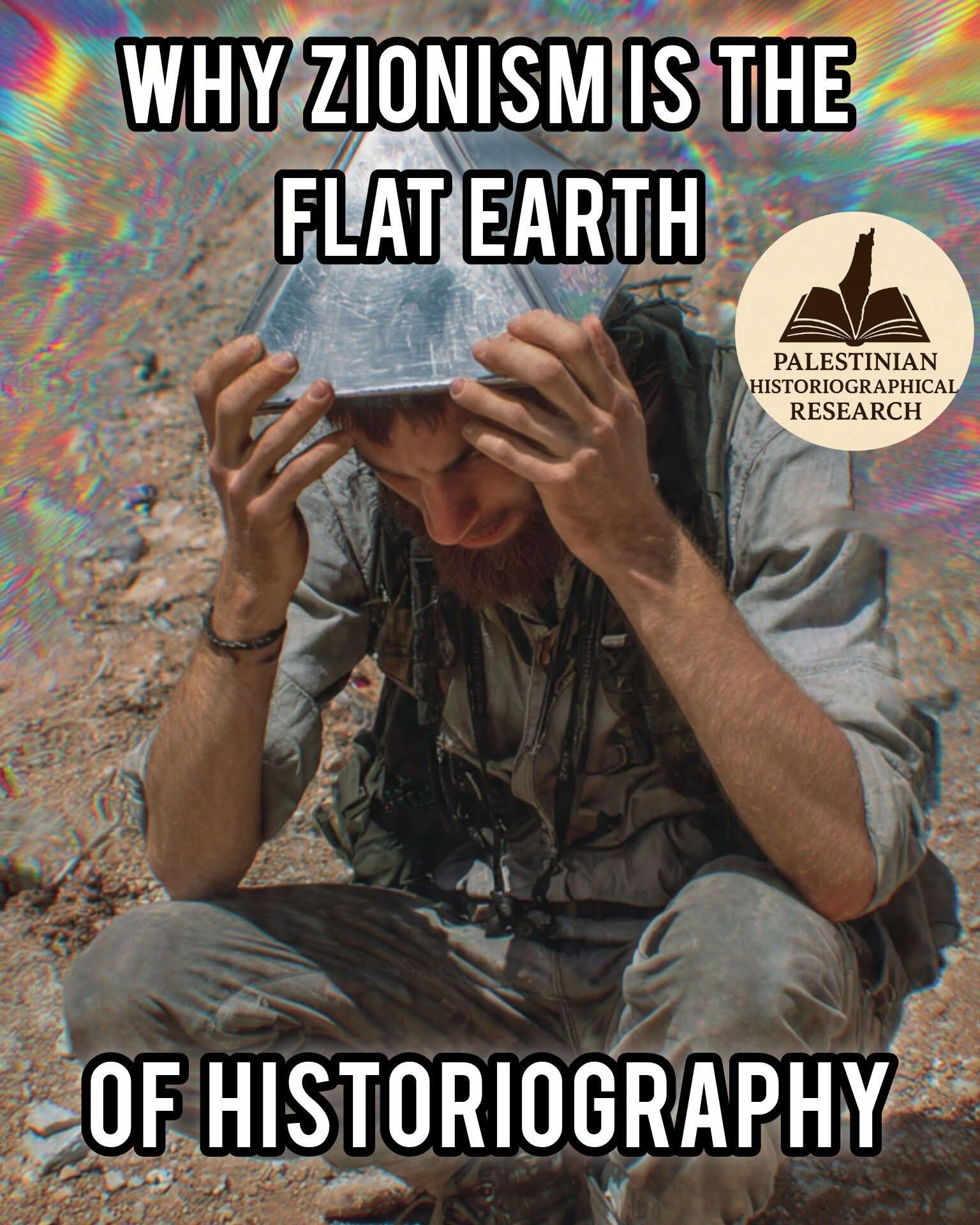
The official historical narrative promoted by Zionism as an ideological and political movement has managed to impose itself as the dominant truth in Israel and much of the West, despite the fact that, for decades, a series of investigations based on declassified archives have fundamentally questioned it. This persistence is not due to the solidity of the facts, but to a systematic rejection of empirical evidence reminiscent of flat Earth thinking: a dogma that ignores verifiable data in favor of emotional or identity-based beliefs. The critique presented here is neither ideological nor political, but strictly methodological; it is based on Israeli primary sources and on the basic principle of historiography: claims about the past must be supported by available documents and testimonies, not myths designed to justify a national project.
This article explores how this narrative was constructed to legitimize Zionism, how it is reproduced in key institutions, and how it operates as a closed system resistant to revision. Two central dogmas refuted by Israeli historians working with their own state archives are analyzed. The goal is to highlight the ethical need for honest history, prioritizing truth over cohesion, to make any form of historical justice possible.
1. The Persistence of a Narrative Resistant to Evidence
In recent decades, a phenomenon has puzzled observers and researchers: how a significant majority of Israelis and international Zionist supporters continue to adhere to an official historical narrative that has been systematically questioned and, in central aspects, refuted by primary documentary evidence. This maintenance against evidence is not due to a lack of data, but to a closure that prioritizes the identity-forming and legitimizing function of the narrative over the scientific verification of the past. Historiography, as a discipline, requires that any claim stands or falls based on available documents; here, however, inconvenient facts are discarded to preserve a convenient version.
Since the late 1980s, Israeli historians such as Benny Morris, Ilan Pappé, Avi Shlaim, and Tom Segev—known as the “new historians,” a label Morris himself initially rejected as superfluous compared to the official traditional historiography, which operated without systematic access to declassified archives—have applied rigorous methods to newly opened Israeli state sources. Their research has revealed, among other things, the existence of planned expulsions and systematic executions of Palestinians during 1948 (Morris, 2004; Pappé, 2006; Shlaim, 2000). Despite international academic recognition of these works, their impact on the Israeli collective imagination has been marginal. This paradox is not merely academic, but reveals deeper dynamics where evidence is perceived as a threat, creating a phenomenon comparable to historical flat Earth thinking.
2. The Construction of a Legitimizing Narrative
Since its origins in the 19th century, the Zionist project understood that achieving a Jewish state in Palestine required not only territorial control but also a historical interpretation that justified it to the international community and internally united its adherents. This narrative was designed to fulfill multiple functions: to present Zionism as a national liberation movement, emphasize the Jewish ancestral connection to the land, and minimize the presence and rights of the native Arab population. As Ilan Pappé (2006) notes, “Zionism not only needed to conquer territory, it also needed to conquer history” (p. 15). This is not a legitimate interpretation among many, but a version that deliberately omits inconvenient facts to support a political project of domination over a preexisting population.
After the declaration of independence in 1948, this version was quickly institutionalized in the education system, the media, the armed forces, and state symbols. Official traditional historiography presented the establishment of the State as the return of an eternally persecuted people to their ancestral home, and the 1948 war as a defensive struggle against a unanimous Arab aggression, in which Palestinians allegedly voluntarily abandoned their homes. This construction offered moral and emotional coherence, although it relied on the systematic omission of documents that, decades later, would demonstrate its incompatibility with the facts.
This initial legitimization was quickly consolidated after the founding of the State, where collective memory was selectively manufactured to reinforce the idea of an empty or hostile territory, ignoring the continuous history of the Palestinian population (Zerubavel, 1995; Kimmerling & Migdal, 2003). The result is a questionable ethic in the teaching of history, prioritizing political justification over documentary truth.
3. A State in Permanent Conflict Does Not Foster Critical Thinking
The stubborn persistence of this narrative is largely explained by the structural context in which Israel develops: a state founded amid war and that, since then, has lived in an almost constant state of conflict or high alert. Under such conditions, history does not primarily operate as a scientific discipline oriented toward critique and revision, but as an instrument of collective cohesion and existential justification. Daniel Bar-Tal (2011) has argued that in societies trapped in intractable conflicts, collective narratives tend to become monolithic, self-justifying, and deeply resistant to any form of self-criticism. Essentially, to maintain group morale and social cohesion, simplified versions are created where one’s own side is always the innocent victim and the other the irrational aggressor, making it extremely difficult to accept facts that challenge this binary image.
In the Israeli case, this dynamic is particularly evident in how historical criticism is perceived as a direct threat to national identity and the perception of security. It is understandable that a society at war seeks cohesion, but it is not acceptable for it to do so at the cost of falsifying its own past. The very legitimacy of the State is anchored in a mythical vision of the past that presents its existence as an inevitable historical necessity; any substantial revision of that vision is experienced as an existential risk that calls into question the very foundations of the national project (Khalidi, 2020).
4. The Reproduction of the Narrative from Childhood
The Israeli educational system plays a central and systematic role in the intergenerational transmission of the official narrative. Numerous academic studies have shown that school textbooks present a highly depoliticized and decontextualized version of the Arab-Israeli conflict, in which the Palestinian population appears invisible, marginalized, or portrayed as a generic threat (Podeh, 2002). Nurit Peled-Elhanan (2012), after an exhaustive analysis of textbooks and school maps, concludes that these materials reproduce “an ethnocentric ideology that legitimizes control over occupied territories and dehumanizes the Palestinian Other” (p. 49), fostering from an early age a vision that justifies domination.
This early socialization is later reinforced by the experience of mandatory military service, an institution in which the narrative of Israel as a permanent historical victim facing existential enemies is repeated and internalized.
Additionally, the predominance of media discourses rarely incorporates dissenting voices or critical perspectives, creating a closed informational environment. The result is a profound epistemic closure: most Israeli citizens grow up and develop without significant exposure to empirical evidence that contradicts the institutionalized official version (Ram, 1998).
5. Two Central Dogmas Refuted by Critical Historiography
The official narrative rests on a series of claims that collide directly with available documentary evidence. Below are two of the most fundamental dogmas:
5.1 Jews were the original indigenous people and at some point constituted the demographic majority in Palestine.
This claim, repeated tirelessly to justify the Zionist “return” as a legitimate restoration, ignores that the Levant was inhabited by multiple peoples prior to the emergence of the ancient Israelites, including Canaanites, Philistines, Jebusites, and other Semitic groups that formed the basis of the continuous population in the region over millennia.
Moreover, demographic data collected during the late Ottoman period and the British Mandate confirm that Jews were always a minority integrated into Arab society before mass immigration promoted by Zionism: in 1800 they represented approximately 2–3% of the population (6,000–7,000 of a total of 275,000 inhabitants); in 1880 around 3–5% (24,000 of 500,000); in 1914 near 8% (60,000 of 750,000); in 1931 17% (174,000 of 1,035,000); and in 1947, on the eve of partition, 32% (630,000 of 1,970,000), of whom more than 70% were immigrants who arrived after 1919 (McCarthy, 1990; Bachi, 1977; Morris, 1999).
5.2 The 1948 war was defensive and moral; aggression came exclusively from the Arabs.
Although the formal intervention of regular Arab armies occurred on May 15, 1948, Jewish forces—Haganah, Irgun, and Lehi—carried out systematic offensive operations from December 1947, including direct attacks on Palestinian villages, psychological terror campaigns, and documented massacres. Plan Dalet, approved in March 1948, explicitly ordered the occupation of territories outside those assigned by the UN and the “cleansing” of Arab villages in strategically considered areas. Before the entry of the Arab armies, Jewish forces had already conquered approximately 25% of the territory projected for the Arab State and expelled more than 250,000 Palestinians through direct military attacks, the destruction of over 200 villages, and a series of massacres confirmed even by Israeli historians (Morris, 2004; Pappé, 2006; Khalidi, 1992).
6. The New Historiography Versus Historical Flat Earth Thinking
In the late 1980s, the mass declassification of Israeli military, diplomatic, and political archives gave rise to a current of critical historiography based on primary sources. Figures such as Benny Morris, Ilan Pappé, Avi Shlaim, and Tom Segev applied rigorous methods for the first time to the State’s own documents, demonstrating the planned nature of many Palestinian expulsions and questioning the official traditional historiography, which Morris himself criticized for its reliance on secondary narratives (Morris, 2004; Shlaim, 2000).
However, this academic innovation was met with widespread hostility in Israel: its authors were marginalized academically, publicly discredited, or labeled as traitors. Even Benny Morris, a pioneer in documenting systematic expulsions, later adopted more nationalist positions without retracting his empirical findings (Morris, 1999).
This collective rejection of documentary evidence perfectly illustrates a society incapable of confronting its own history and thus constructs a closed system in which any evidence contrary to the official narrative is perceived as an external threat or conspiracy, prioritizing the legitimizing and emotional function of the myth over the scientific verification of the past (Masalha, 2012).
Conclusion
The official Israeli historical narrative does not survive thanks to evidence, but in spite of it. Its persistence is explained by the intertwining of political, military, educational, and psychological factors that protect it from rigorous critique. As long as Israel continues to operate under a permanent state of exception and its education system instrumentalizes history to justify irrational present-day policies, Israeli society will struggle to understand the difference between dominant public discourse and verifiable historical reality.
Recognizing this epistemological dynamic—analogous to flat Earth thinking in its systematic rejection of established facts—represents an invitation to demystify the past, confront it with intellectual honesty, and construct a shared memory that makes historical justice and reconciliation possible (Bar-Tal, 2011; Khalidi, 2020).
References
- Bachi, R. (1977). The population of Israel. Hebrew University.
- Bar-Tal, D. (2011). Intractable conflicts: Socio-psychological foundations and dynamics. Cambridge University Press.
- Khalidi, W. (Ed.). (1992). All that remains: The Palestinian villages occupied and depopulated by Israel in 1948. Institute for Palestine Studies.
- Khalidi, R. (2020). The hundred years’ war on Palestine. Metropolitan Books.
- Kimmerling, B., & Migdal, J. S. (2003). The Palestinian people: A history. Harvard University Press.
- Masalha, N. (2012). The Palestine Nakba: Decolonising history, narrating the subaltern, reclaiming memory. Zed Books.
- McCarthy, J. (1990). The population of Palestine: Population statistics of the late Ottoman period and the Mandate. Columbia University Press.
- Morris, B. (1999). Righteous victims: A history of the Zionist-Arab conflict, 1881–1999. Knopf.
- Morris, B. (2004). The birth of the Palestinian refugee problem revisited. Cambridge University Press.
- Pappé, I. (2006). The ethnic cleansing of Palestine. Oneworld Publications.
- Peled-Elhanan, N. (2012). Palestine in Israeli school books: Ideology and propaganda in education. I.B. Tauris.
- Podeh, E. (2002). The Arab-Israeli conflict in Israeli history textbooks, 1948–2000. Bergin & Garvey.
- Ram, U. (1998). The colonization perspective in Israeli sociology. In I. Pappé (Ed.), The Israel/Palestine question (pp. 55–80). Routledge.
- Shlaim, A. (2000). The iron wall: Israel and the Arab world. W.W. Norton.
- Zerubavel, Y. (1995). Recovered roots: Collective memory and the making of Israeli national tradition. University of Chicago Press.






One Comment