Summary
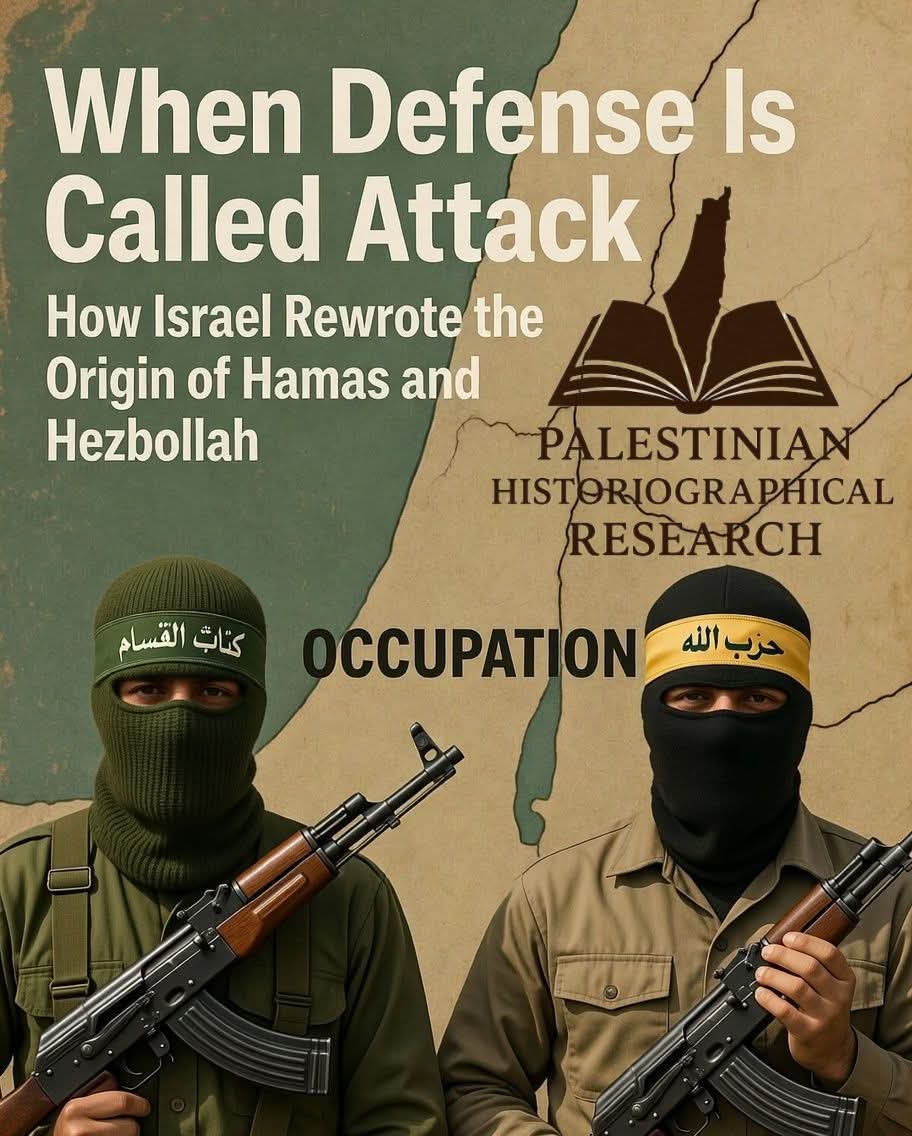
Hamas was founded in 1987, nearly forty years after the Nakba of 1948 — which forcibly displaced over 700,000 Palestinians and allowed Israel to take control of 78% of historic Palestine, including a large portion of the territory assigned to the proposed Arab state under the United Nations Partition Plan — and twenty years after Israel’s military occupation of the Gaza Strip and the West Bank in 1967. Hezbollah formally emerged on the global stage in 1985, although its armed structures had been operating since shortly after Israel’s 1982 invasion of Lebanon (Operation Peace for Galilee). That operation, which far exceeded its stated objective of neutralizing PLO bases, led to an eighteen-year occupation (1982–2000) and facilitated atrocities such as the Sabra and Shatila massacres. Both movements arose in response to decades of dispossession, occupation, and repression. Yet the dominant Israeli narrative — widely echoed in Western media — has systematically inverted this chronology, portraying Hamas and Hezbollah as the original aggressors while erasing the political and social dimensions of their resistance, reducing it to mere terrorism.
When a group is universally labeled “terrorist,” its historical origins, social base, and the causes that gave rise to it vanish from the narrative. This article deliberately restores that frequently silenced context — not to glorify Hamas or Hezbollah, but to present the conflict in its true chronological and political complexity. Deliberately targeting civilians constitutes a war crime and/or a crime against humanity under international humanitarian law; no civilian victim — Palestinian, Lebanese, Israeli, or of any other nationality — can ever be justified or minimized.
1. Historical and Chronological Context
Since the establishment of the State of Israel in 1948, the dispossession, displacement, and marginalization of the Palestinian population have been continuous.
The Nakba of 1948 forced over 700,000 Palestinians into exile (Pappé, 2006; Morris, 2004), laying the foundations of a conflict that persists today. Between late November 1947 and mid-May 1948, roughly 300,000 Palestinians had already been displaced before Israel’s declaration of independence, as Zionist paramilitary groups such as Haganah, Irgun, and Lehi intensified attacks, massacres, and village destructions. Most fled with little warning, taking only what they could carry, expecting to return quickly — a return that never occurred.
In 1967, Israel’s occupation of Gaza and the West Bank escalated the situation, extending military control over the remaining Palestinian territories and populations (Gordon, 2010).
2. Hamas: From Social Network to Armed Resistance
Hamas was formed in December 1987 amid the First Intifada, a popular uprising against the conditions of occupation and repression (Gunning, 2007).
Its roots lie in the Muslim Brotherhood in Palestine, established in the 1940s, which gained momentum in the Occupied Territories after 1967 as a network of charity and social services known as Mujama al-Islamiya.
Israeli authorities initially tolerated, and according to multiple sources including former military governor Brigadier General Yitzhak Segev, even indirectly funded Mujama as a counterweight to the secular, nationalist Palestine Liberation Organization (PLO) led by Fatah (Abu-Amr, 1994; Milton-Edwards & Farrell, 2010; Chehab, 2007; Roy, 2011).
This policy of divide-and-rule backfired spectacularly. During the Intifada — marked by prolonged curfews, home demolitions, mass arrests, and the use of live fire against unarmed demonstrators, which left hundreds of Palestinians dead (Kimmerling & Migdal, 2003) — the Islamist movement radicalized and created its armed branch.
In 1988, Hamas published its Charter, declaring armed resistance against the occupation an Islamic duty (Hroub, 2006).
The immediate trigger of the Intifada was an incident in Jabalia in December 1987, when an Israeli truck killed four Palestinian workers. However, it reflected the accumulated frustration of two decades of military rule, land expropriations for illegal settlements, and systematic human rights violations documented by B’Tselem and Amnesty International (Gordon, 2010; Pappé, 2017).
Hamas positioned itself not only as a military force but also as a provider of social welfare in the vacuum left by the corrupt Palestinian Authority and the occupying power itself (Tamimi, 2007). Its emergence was neither spontaneous nor exclusively militaristic; it was the fusion of social, religious, and political forces responding to prolonged occupation.
3. Hezbollah: From Invasion to Resistance
Hezbollah began to take shape as a political-military organization immediately after Israel’s invasion of Lebanon on June 6, 1982, although it publicly announced its existence with the “Open Letter” manifesto of February 16, 1985 (Norton, 2007).
The invasion, launched under the pretext of neutralizing PLO threats in southern Lebanon, quickly escalated beyond its stated objectives, reaching Beirut and producing an occupation that lasted until 2000 (Hirst, 2010; Fisk, 2001).
Led by Defense Minister Ariel Sharon and Prime Minister Menachem Begin, the operation aimed not only to destroy PLO infrastructure but also to reshape Lebanese politics in favor of Israel’s Phalangist allies — a clear violation of Lebanese sovereignty (Anziska, 2018; Schiff & Ya’ari, 1984).
The invasion caused thousands of Lebanese and Palestinian civilian deaths, destroyed infrastructure, and deepened sectarian divides, radicalizing the historically marginalized Shiite community (Norton, 2007; El-Khazen, 2000).
In September 1982, the Sabra and Shatila massacres occurred. After the assassination of President-elect Bachir Gemayel, Israeli forces surrounded Palestinian refugee camps in West Beirut, illuminated them with flares, and allowed allied Phalangist militias to enter.
Over three days, the militias massacred between 800 and 3,500 civilians — mostly women, children, and the elderly (Kapeliouk, 1984; Kahan Commission, 1983; United Nations, 1983).
The Israeli army controlled the perimeter and prevented escape or external intervention. Israel’s own Kahan Commission (1983) found Ariel Sharon indirectly responsible and recommended his removal as Defense Minister, while the independent MacBride Commission documented Israeli complicity in serious violations of international humanitarian law (MacBride et al., 1983).
These events dramatically intensified anti-Israeli sentiment among Lebanese Shiites and became a decisive catalyst for the consolidation of Hezbollah as an armed resistance movement.
4. Narrative Inversion and the Criminalization of Resistance
A central strategy of official Israeli discourse — and much of Western media coverage — has been the systematic inversion of the chronological and causal sequence of the conflict.
By portraying Hamas and Hezbollah as the original aggressors and Israel as perpetually “responding” or “defending itself,” this narrative erases the occupations, invasions, massacres, and structural violence that actually gave rise to both movements (Chomsky, 1983; Hirst, 2010).
This inversion serves a clear political purpose: it depoliticizes both organizations, reducing them to mere “terrorist groups” devoid of context, grievances, or popular support.
In reality, both Hamas and Hezbollah maintain extensive social service networks — hospitals, schools, reconstruction programs, food distribution, and microfinance initiatives reaching hundreds of thousands of people. Hamas has won elections (2006) and governed Gaza since 2007; Hezbollah has been the largest single bloc in the Lebanese parliament since 1992 and has repeatedly led or participated in governments.
This political-military duality is not an anomaly but a historical pattern among anti-colonial and resistance movements (from the IRA to the ANC, from Viet Minh to FLN). Denying it in these cases strips Palestinian and Lebanese Shiite communities of political agency and legitimizes collective punishment against the populations they represent (Gunning, 2007; Norton, 2007).
5. The Political Dimension as Key to Understanding the Conflict
Failing to recognize the profoundly political nature of Hamas and Hezbollah produces analyses that are not only historically inaccurate but also functionally complicit in perpetuating the conflict.
These are not “terrorist organizations” that emerged in a vacuum; they are political actors filling governance voids created by occupation, corruption, or state collapse. They enjoy genuine popular legitimacy precisely because they provide basic services that neither the occupying power nor formal state authorities deliver.
Their military wings exist because diplomatic and legal avenues to end occupation have been systematically blocked for decades. Their social wings exist because occupation and blockade deliberately prevent alternative service providers.
As long as the root causes — military occupation, siege, dispossession, and denial of self-determination — remain unaddressed, these movements will continue to regenerate, regardless of how many leaders are assassinated or how much infrastructure is destroyed.
Conclusion
Hamas and Hezbollah are, at their core, resistance movements born of concrete historical processes: the ethnic cleansing and territorial expansion of 1948, the occupation of the remaining Palestinian territories in 1967, and the devastating invasion and eighteen-year occupation of Lebanon beginning in 1982.
Portraying them as the original causes rather than the consequences of the conflict is not just a historical error; it is an ideological operation that sustains power asymmetry and blocks any path toward justice.
Only by restoring the real chronological and causal sequence can we begin to understand the conflict — and, more importantly, start to resolve it.
References
- Abu-Amr, Z. (1994). Islamic fundamentalism in the West Bank and Gaza. Indiana University Press.
- Alagha, J. (2011). Hizbullah’s identity construction. Amsterdam University Press.
- Anziska, S. (2018). Preventing Palestine. Princeton University Press.
- Chehab, Z. (2007). Inside Hamas. I.B. Tauris.
- Chomsky, N. (1983). The fateful triangle. South End Press.
- El-Khazen, F. (2000). The breakdown of the state in Lebanon, 1967-1976. Harvard University Press.
- Fisk, R. (2001). Pity the nation. Nation Books.
- Gordon, N. (2010). Israel’s occupation. University of California Press.
- Gunning, J. (2007). Hamas in politics. Columbia University Press.
- Hirst, D. (2010). Beware of small states. Nation Books.
- Hroub, K. (2006). Hamas: A beginner’s guide. Pluto Press.
- Kahan Commission. (1983). Report of the Commission of Inquiry into the Events at the Refugee Camps in Beirut.
- Kapeliouk, A. (1984). Sabra & Shatila: Inquiry into a massacre. Association of Arab-American University Graduates.
- Kimmerling, B., & Migdal, J. S. (2003). The Palestinian people: A history. Harvard University Press.
- MacBride, S., et al. (1983). Israel in Lebanon. Ithaca Press.
- Milton-Edwards, B., & Farrell, S. (2010). Hamas: The Islamic resistance movement. Polity Press.
- Morris, B. (2004). The birth of the Palestinian refugee problem revisited. Cambridge University Press.
- Norton, A. R. (2007). Hezbollah: A short history. Princeton University Press.
- Pappé, I. (2006). The ethnic cleansing of Palestine. Oneworld Publications.
- Pappé, I. (2017). The biggest prison on earth. Oneworld Publications.
- Roy, S. (2011). Hamas and civil society in Gaza. Princeton University Press.
- Schiff, Z., & Ya’ari, E. (1984). Israel’s Lebanon war. Simon and Schuster.
- Tamimi, A. (2007). Hamas: Unwritten chapters. Hurst & Company.
- United Nations. (1983). Report of the Commission of Inquiry on the events at Sabra and Shatila.