Introduction
By the 1910s, various Palestinian organizations already existed, both in the region and in places as far away as Chile. At that time, the Palestinian Arab population had a dominant vernacular language (Palestinian Arabic), a rooted culture, and an ancestral, millennia-long connection to the land of which they were the overwhelming demographic majority. In contrast, the territory that today comprises Israel and the occupied territories lacked a significant local Jewish population—only about 5–8% throughout the 1910s, reaching approximately 8% by 1914—the majority of whom were recent immigrants (McCarthy, 1990)—had no majority vernacular language (modern Hebrew was a language recently revived by a minority ideological project, not the everyday language of the population), nor did it possess a uniform national culture. Even the name “Israel” as a consensual designation for a Jewish state was not adopted until May 1948, with the proclamation of the state by David Ben-Gurion, in the midst of the 1947–1948 ethnic cleansing of Palestine.
Contrary to what Western political and media propaganda has persistently disseminated for decades, Palestinian national identity predates Israeli national identity by far. This is not an interpretive argument but a conclusion supported by historical facts, political, demographic, cultural, and administrative processes widely documented by contemporary academic historiography. Research on the emergence of Palestinian nationalism highlights the role of internal Arab factors—such as the development of local political elites, the decline of the Ottoman Empire, and prior territorial dynamics—which preceded and shaped the response to Zionism (Muslih, 1988; Foster, 2007; Kimmerling & Migdal, 1993; Schölch, 1993). These roots trace back, in embryonic forms, even to events such as the 1834 peasant revolt and solidify in the 19th and early 20th centuries with the emergence of a differentiated territorial consciousness.
Although nationalism and the nation-state model are modern phenomena—consolidated in Europe during the 19th century and emerging in the Middle East in the early 20th century, following the fall of the Ottoman Empire and the colonial reorganization of the region (Hobsbawm, 1990; Anderson, 2006; Gelvin, 2014)—and, consequently, no national identity could exist in state form before the advent of the nation-state idea, this did not prevent the germination and development of a Palestinian national consciousness from the 19th century, particularly among indigenous Arab populations. This process accelerated with exposure to European ideas and the consolidation of a sense of territorial community among Palestinian Arabs, long before Zionist immigration reached significant volumes (Muslih, 1988; Porath, 1974; Sayigh, 1977). Zionism, as an ideology and organized movement, emerged as a project of a diasporic Jewish minority at the end of the 19th century, without a majority demographic or cultural base in Palestine.
1. Palestinian Identity in Formation and Israeli Void (19th Century – 1911)
From the second half of the 19th century, the Arab population of Palestine—both Muslim and Christian—began to develop a modern territorial consciousness explicitly linked to the Palestinian space. This process manifested in local administrative practices, Arabic literature produced in the territory, urban associations, educational networks, and early forms of political mobilization against Ottoman authorities (Doumani, 1995; Khalidi, 1997; Campos, 2011). Palestinian elites, such as notable families of Jerusalem and Nablus, played a key role in articulating local demands within the context of emerging Arabism, responding not only to Zionism but also to internal Ottoman reforms (Muslih, 1988; Gerber, 2008).
This development did not occur in a vacuum. When the newspaper Al-Karmil, directed by Najib Nassar, was founded in Haifa in 1908, the Jewish population in Palestine represented approximately 5–8% of the total. Its explicit objective was to warn about the effects of political Zionism and defend the territorial rights of the Arab inhabitants of Palestine, employing for the first time a modern political discourse clearly territorialized (McCarthy, 1990; Kabha, 2007). At that time, no Israeli national identity existed, nor was there a defined state project in the territory, nor a culturally unified Jewish population. Early Zionism was a fragmented ideological movement influenced by European debates on Jewish identity, but lacking a cohesive territorial base in Palestine (Shapira, 2012; Laqueur, 1972).
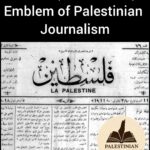
Similarly, when the newspaper Filastin (Palestine) was founded in Jaffa in 1911 by Palestinian Christians Isa al-Isa and Yusuf al-Isa, the Jewish population had increased due to early waves of Zionist immigration but still did not exceed approximately 8% of the total Palestinian population (McCarthy, 1990). Filastin explicitly articulated an inclusive Palestinian identity—Muslim and Christian—centered on territory, the Arabic language, and the defense of the political rights of the indigenous majority (Khalidi, 1997; Kabha, 2007). These newspapers not only reflected a national consciousness in formation but actively promoted it, educating the population about external threats and fostering a sense of unity (Foster, 2007; Abu-Ghazaleh, 1973).
In contrast, during the same period, the concept of “Israel” did not exist, nor was there consensus within Zionism regarding the name of a possible state, its borders, or its national language. Zionism was a European ideological movement external to Palestinian territory, not a local national identity. The Jewish communities present in Palestine were culturally and linguistically fragmented, speaking Yiddish, Ladino, Judeo-Arabic, or other languages, and lacked a unified national culture (Kimmerling, 2001; Sand, 2009). The idea of a unified Israeli identity would only consolidate decades later through state and migratory processes after 1948 (Shapira, 2012). This process included the deliberate revitalization of Hebrew, a language that had been dead for approximately 1,800 years without continuous vernacular use, promoted by figures such as Eliezer Ben-Yehuda from the late 19th century. The forced modernization of Hebrew implied the suppression of native languages of Jewish diasporas, such as Yiddish or Ladino, through state policies that prohibited their use in public and educational contexts to impose artificial linguistic uniformity (Harshav, 1993; Fellman, 1973; Zuckermann, 2003; Safran, 2005).
2. Palestinian Demographic Majority and Self-Determination
For millennia and until the ethnic cleansing of Palestine, the Arab population constituted the overwhelming demographic, social, and economic majority of the territory. This majority provided the material basis on which early claims to national self-determination were articulated, in accordance with modern political principles spreading globally (Khalidi, 1997). Reliable demographic estimates indicate an Arab majority of over 97% in 1800 (275,000 total inhabitants, with only 7,000 Jews), approximately 96% in 1890 (532,000 total inhabitants, with about 18,000–20,000 Jews), approximately 94% in 1914 (around 737,000 total inhabitants, with about 59,000 Jews), and approximately 82% in 1930 (McCarthy, 1990).
The existence of Palestinian institutions outside the territory, such as the “Club Sportivo Palestina” founded in Chile in 1916, demonstrates that Palestinian national identity already had international representation decades before 1948. During the same period, no comparable Israeli national identity existed, either inside or outside Palestine (Khalidi, 1997). During the British Mandate, Jewish immigration increased drastically, but the Arab majority persisted until 1948, representing 67% (1,269,000 Arabs versus 608,000 Jews out of a total population of 1,850,000) (McCarthy, 1990). This demographic dynamic underscores how Palestinian self-determination was obstructed by British colonial and Zionist interventions, which prioritized European immigration over indigenous rights (Gelvin, 2014; Pappé, 2006; Schölch, 1993).
3. Millennia-Old Historical Rooting and Contemporary Genetic Evidence
Modern Palestinian national identity developed over a deep historical connection between the local population and the territory, preceding modern concepts of nation and state. Recent genetic studies confirm significant population continuity in the southern Levant, indicating that modern Palestinians derive a substantial part of their ancestry from ancient Levantine populations (Haber et al., 2017; Agranat-Tamir et al., 2020). Ancient DNA analyses of Levantine remains reveal that modern Palestinians’ ancestry consistently derives from Bronze Age Canaanite peoples; on average, Palestinians show higher local genetic correlation with ancient Levantine inhabitants than modern Israeli Jews, who, as more distant genetic relatives, incorporate greater European and other diaspora influences (Agranat-Tamir et al., 2020; Lawler, 2020; Xue et al., 2024). This evidence does not define national identity but contextualizes Palestinian territorial rootedness and refutes narratives of population discontinuity propagated by the Israeli state narrative (Lazaridis et al., 2016; Elhaik, 2013; Nebel et al., 2000).
4. Late Construction of Israeli National Identity
Israeli national identity was constituted exclusively after 1948, through the creation of the state, the adoption that same year of the name Israel for that territory, mass immigration, institutional unification, and the forced revitalization of modern Hebrew as a national language after nearly two millennia without continuous vernacular use (Kimmerling, 2001; Sand, 2009; Shapira, 2012). Before that moment, no Israeli national identity existed in Palestinian territory, only an ideological project in the process of implementation. The formation of this identity involved integrating diverse Jewish diasporas, with dominant European influences, and relied on selective historical narratives emphasizing ancient connections while minimizing the Palestinian indigenous presence (Sand, 2009; Shapira, 2012). This constructivist process included the invention of collective myths, such as the recovery of biblical roots through state collective memory, ignoring internal diversity and prioritizing imposed ethnic homogeneity (Zerubavel, 1995; Ram, 2006). Early Israeli historiography, influenced by Zionism, promoted a unified national identity through education and state rituals, marginalizing non-Ashkenazi and Arab voices, revealing the exogenous and artificial nature of this construction (Shenhav, 2006; Yonah & Shenhav, 2005; Sternhell, 1998; Peled, 1992; Boyarin, 1997).
Conclusion
Comparative historical analysis demonstrates that Palestinian national identity predates Israeli national identity by far. While the former gradually emerged from the 19th century as a political expression of a territorially rooted indigenous majority, the latter formed late, in a state-based and exogenous manner, from the mid-20th century onward. Denying this sequence is not an academic position but a historical distortion driven by colonial and Zionist narratives that ignore overwhelming demographic, genetic, and cultural evidence.
This distortion is perpetuated in contemporary propaganda, erasing Palestinian rootedness to justify occupation and territorial expansion. However, critical historiography reveals that Palestinian nationalism, forged in response to external threats but anchored in internal dynamics, predates and challenges the legitimacy of an imported Zionist project. Recognizing this precedence not only corrects historical falsehoods but underscores the need for justice for a people whose identity has been systematically denied.
Finally, in a context of prolonged conflict, understanding the precedence of Palestinian identity invites reconsideration of political solutions that respect indigenous self-determination, refuting myths of a “land without a people” and promoting dialogue based on irrefutable historical facts.
References
-
- Abu-Ghazaleh, A. (1973). Arab cultural nationalism in Palestine during the British Mandate. Institute for Palestine Studies.
- Agranat-Tamir, L., et al. (2020). The genomic history of the Bronze Age southern Levant. Cell, 181(5), 1146–1157.e11. [Access full article via Cell]
- Anderson, B. (2006). Imagined communities: Reflections on the origin and spread of nationalism (Rev. ed.). Verso.
- Arnaiz-Villena, A., et al. (2001). The origin of Palestinians and their genetic relatedness with other Mediterranean populations. Human Immunology, 62(9), 889–900.
- Boyarin, D. (1997). Unheroic conduct: The rise of heterosexuality and the invention of the Jewish man. University of California Press.
- Campos, M. U. (2011). Ottoman brothers: Muslims, Christians, and Jews in early twentieth-century Palestine. Stanford University Press.
- Doumani, B. (1995). Rediscovering Palestine: Merchants and peasants in Jabal Nablus, 1700-1900. University of California Press.
- Elhaik, E. (2013). The missing link of Jewish European ancestry: Contrasting the Rhineland and the Khazarian hypotheses. Genome Biology and Evolution, 5(1), 61–74.
- Fellman, J. (1973). The revival of a classical tongue: Eliezer Ben Yehuda and the modern Hebrew language. Mouton.
- Foster, Z. J. (2007). The emergence of a Palestinian national identity: A theory-driven approach. Michigan Journal of History, 4(2), 1–22. [View full PDF]
- Gelvin, J. L. (2014). The Israel-Palestine conflict: One hundred years of war (3rd ed.). Cambridge University Press.
- Gerber, H. (2008). Remembering and imagining Palestine: Identity and nationalism from the Crusades to the present. Palgrave Macmillan.
- Haber, M., et al. (2017). Continuity and admixture in the last five millennia of Levantine history from ancient Canaanite and present-day Lebanese genome sequences. American Journal of Human Genetics, 101(2), 274–282. [Access via PMC]
- Harshav, B. (1993). Language in time of revolution. University of California Press.
- Hobsbawm, E. J. (1990). Nations and nationalism since 1780: Programme, myth, reality. Cambridge University Press.
- Kabha, M. (2007). The Palestinian press as shaper of public opinion 1929-1939: Writing up a storm. Vallentine Mitchell.
- Khalidi, R. (1997). Palestinian identity: The construction of modern national consciousness. Columbia University Press.
- Kimmerling, B. (2001). The invention and decline of Israeliness: State, society, and the military. University of California Press.
- Kimmerling, B., & Migdal, J. S. (1993). Palestinians: The making of a people. Free Press.
- Laqueur, W. (1972). A history of Zionism. Holt, Rinehart and Winston.
- Lawler, A. (2020, May 28). DNA from the Bible’s Canaanites lives on in modern Arabs and Jews. National Geographic.
- Lazaridis, I., et al. (2016). Genomic insights into the origin of farming in the ancient Near East. Nature, 536(7617), 419–424.
- McCarthy, J. (1990). The population of Palestine: Population history and statistics of the late Ottoman period and the Mandate. Columbia University Press.
- Morris, B. (2004). The birth of the Palestinian refugee problem revisited. Cambridge University Press.
- Muslih, M. Y. (1988). The origins of Palestinian nationalism. Columbia University Press.
- Nebel, A., et al. (2000). High-resolution Y chromosome haplotypes of Israeli and Palestinian Arabs reveal geographic substructure and substantial overlap with haplotypes of Jews. Human Genetics, 107(6), 630–641.
- Pappé, I. (2006). The ethnic cleansing of Palestine. Oneworld.
- Peled, Y. (1992). Ethnic democracy and the legal construction of citizenship: Arab citizens of the Jewish state. American Political Science Review, 86(2), 432–443.
- Porath, Y. (1974). The emergence of the Palestinian-Arab national movement, 1918-1929. Frank Cass.
- Ram, U. (2006). Time, space and hierarchy: Israeli sociologists narrate the birth of the nation. Sociétés Contemporaines, 64(4), 67–89.
- Safran, W. (2005). Language and nation-building in Israel: The influence of state ideology. International Journal of the Sociology of Language, 2005(171), 7–22.
- Sand, S. (2009). The invention of the Jewish people. Verso.
- Sayigh, R. (1977). Sources of Palestinian nationalism: A study of a Palestinian camp in Lebanon. Journal of Palestine Studies, 6(4), 17–40.
- Schölch, A. (1993). Palestine in transformation, 1856-1882: Studies in social, economic and political development. Institute for Palestine Studies.
- Shapira, A. (2012). Israel: A history. Brandeis University Press.
- Shenhav, Y. (2006). The Arab Jews: A postcolonial reading of nationalism, religion, and ethnicity. Stanford University Press.