
Introduction
For nearly five centuries, Jerusalem was effectively closed to permanent Jewish residence. Following the Jewish defeats at the hands of the Roman Empire in the first and second centuries CE—most decisively after the Bar Kokhba revolt (132–135 CE)—the city was refounded as Aelia Capitolina. A set of restrictions was imposed that excluded Jews from urban life in Jerusalem for an extended period (Goodman, 2007; Irshai, 2002).
This condition endured, with only minor fluctuations, throughout the period of Christian Byzantine rule. Imperial policies during this era reinforced Jewish exclusion as part of a broader strategy to consolidate Christian dominance over the holy city.
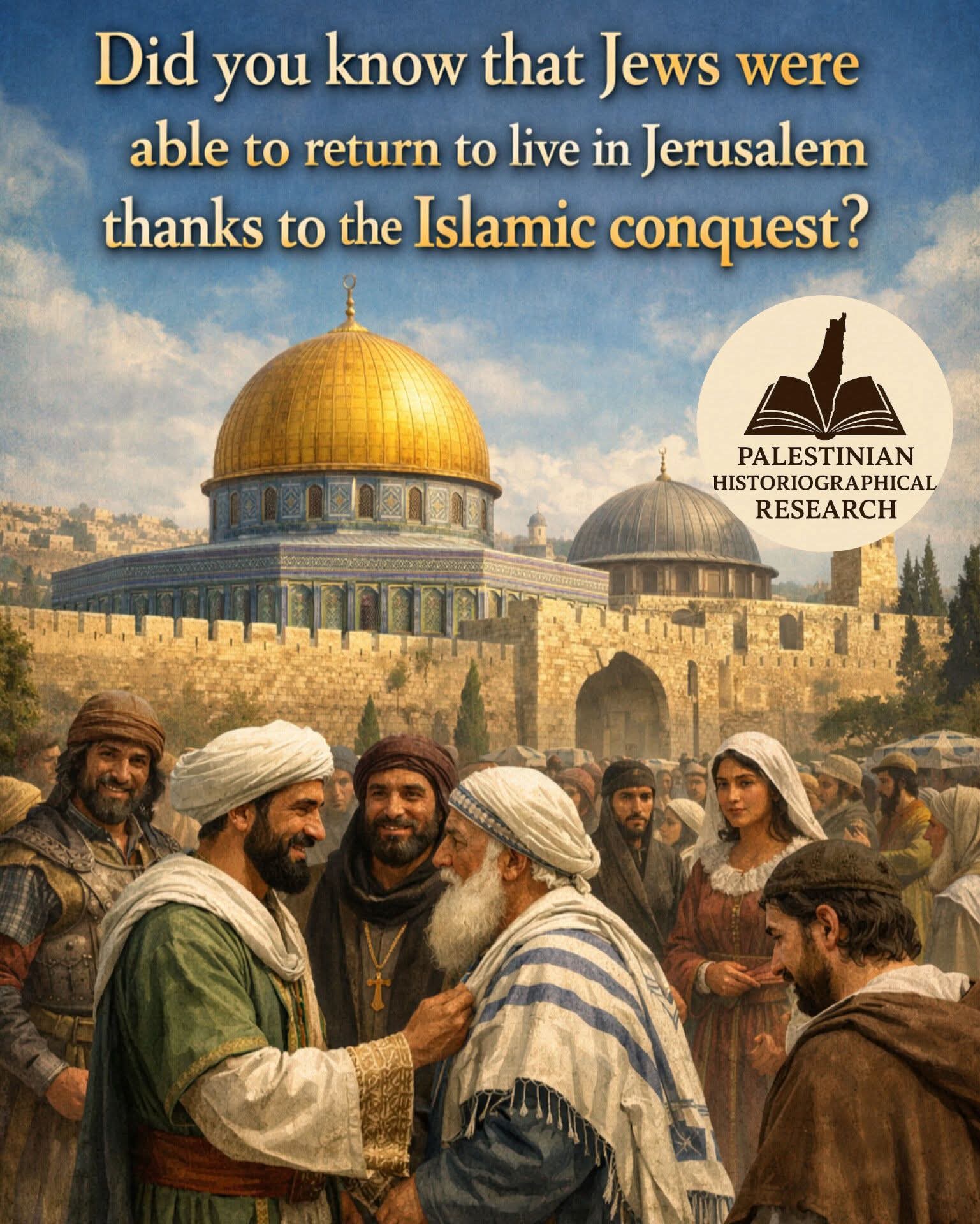
A decisive shift occurred in the seventh century, when Jerusalem passed from Byzantine authority to the control of the emerging Islamic polity. Scholarly consensus holds that the Islamic conquest of Jerusalem in 637–638 CE introduced a new legal and social order that once again permitted Jewish residence in the city. This development is a historically documented phenomenon and is widely recognized in modern historiography (Gil, 1992; Prawer & Ben-Shammai, 1996; Donner, 2010).
This transformation brought substantial relief to long-marginalized Jewish communities and stood in sharp contrast to the exclusionary regimes that preceded it. The new order enabled a degree of urban plurality that had been absent under Byzantine administration.
In contemporary debates, however, this historical episode is frequently downplayed within Zionist and Israeli narratives that emphasize an exclusive Jewish bond to Jerusalem. Such narratives often overlook periods of interreligious coexistence in order to bolster modern territorial claims (Shapira, 2012; Khalidi, 1997). Academic scholarship demonstrates how selective readings of the past can obscure the city’s complex historical trajectory and exacerbate present-day tensions.
1. Jerusalem under Roman and Byzantine rule
1.1 Expulsion and prohibition of residence
The destruction of the Second Temple in 70 CE initiated a process of increasing marginalization of Jerusalem’s Jewish population. This process unfolded in the context of the Judeo-Roman wars, which culminated in large-scale violence, massacres, and widespread dispersal.
Following the Bar Kokhba revolt, exclusion was institutionalized. Emperor Hadrian refounded Jerusalem as a pagan Roman colony under the name Aelia Capitolina and explicitly banned Jewish residence in the city and its immediate surroundings, allowing only limited symbolic exceptions (Goodman, 2007; Schäfer, 2003).
These measures erased organized Jewish life from the city. Pagan temples were erected on sites of Jewish religious significance, and Jerusalem was reshaped into an urban space devoid of Jewish communal presence for centuries.
1.2 Christian Jerusalem in the Byzantine era
During the Byzantine period (fourth to seventh centuries), Jerusalem was transformed into an explicitly Christian city following Constantine’s conversion. Monumental constructions, most notably the Church of the Holy Sepulchre, were accompanied by policies that continued to restrict Jewish presence.
Imperial legislation further entrenched marginalization, while episodes of violence—including pogroms and forced conversions—occurred under rulers such as Emperor Heraclius. After recapturing Jerusalem in 629 CE, Heraclius expelled the city’s Jewish population once again (Irshai, 2002; Wilken, 1992).
The Christian identity imposed on Jerusalem was constructed through Jewish exclusion, portraying Jews as unworthy inhabitants of the holy city. This pattern of intolerance provides a stark contrast to the arrangements that followed under Islamic rule and illustrates the persistence of religious exclusivism across successive regimes.
2. The Islamic conquest of Jerusalem
2.1 The end of Byzantine rule
In 637–638 CE, Jerusalem was conquered by the forces of the Rashidun Caliphate after a negotiated siege. The city surrendered peacefully to Caliph Umar ibn al-Khattab, who concluded a treaty with Patriarch Sophronius (Kennedy, 2007; Donner, 2010).
The transition of power proceeded in an orderly manner. Christian institutions were preserved, and the existing social structure remained largely intact. Muslim historical accounts emphasize acts of restraint and tolerance, including Umar’s refusal to pray inside the Church of the Holy Sepulchre so as not to appropriate it as a mosque.
This moment marked the end of centuries of Greco-Roman and Byzantine exclusivity and introduced a governing approach that favored incorporation rather than eradication.
2.2 A new legal framework for religious minorities
Under early Islamic governance, Jews and Christians were recognized as People of the Book. They were permitted to practice their religions and reside in Muslim-controlled cities in exchange for fiscal obligations such as the jizya (Donner, 2010; Levy-Rubin, 2011).
The Pact of Umar established guarantees of security and protection for religious sites and communities. These provisions enabled Jewish reintegration into Jerusalem after centuries of formal exclusion. While the system imposed a hierarchical structure, it nevertheless allowed economic participation, communal organization, and cultural continuity in ways that differed markedly from Byzantine policies.
Evidence from the Cairo Geniza points to relative stability for religious minorities operating within this framework (Gil, 1992; Cohen, 1999).
3. The Jewish return to Jerusalem in the early Islamic period
3.1 Historiographical evidence of Jewish settlement
Following the Islamic conquest, Jewish groups resettled in Jerusalem and reconstituted organized communal life. Synagogues and rabbinical institutions were already functioning within the first decades after 638 CE (Gil, 1992).
Documents preserved in the Cairo Geniza—including correspondence, legal contracts, and personal records dating from the seventh century onward—attest to a continuous Jewish presence in the city. These sources reference Jewish families residing in Jerusalem and participating in regional trade networks (Goitein, 1983). Archaeological findings, such as administrative seals and material remains uncovered near the Temple Mount and dated to the seventh century, further suggest an organized Jewish community (Avni, 2014).
Contemporary Jewish apocalyptic writings, including Sefer Zerubbabel and The Secrets of Rabbi Simon bar Yohai, interpret the Muslim conquest as liberation from Byzantine oppression. In these texts, Muslim rulers are portrayed as facilitators of Jewish return (Lecker, 2012; Himmelfarb, 1990). Early Muslim historians, among them al-Tabari, also record instances of local Jewish support during the siege, reportedly offered in exchange for assurances of safe return (al-Tabari, 1990).
Taken together, this body of evidence challenges interpretations that downplay the significance of early Islamic rule in the history of Jewish Jerusalem.
3.2 Scope and limits of the return
The new conditions permitted legal residence and the reconstruction of communal institutions. Rabbinical academies established in Jerusalem during this period attracted scholars throughout the eighth and ninth centuries (Gil, 1992; Mann, 1920).
Geniza documents further reveal patterns of commercial cooperation between Jews and Muslims. Jewish residents were active in trades such as dyeing and long-distance commerce, contributing to the city’s economic vitality under the Umayyad and Abbasid dynasties (Cohen, 1999; Goitein, 1983). Demographic estimates suggest that the Jewish population expanded from several hundred individuals in the seventh century to several thousand by the tenth century, marking a substantial revival (Gil, 1992).
Although Jews remained subject to the restrictions of the dhimmi system—including limitations on religious construction—this period afforded greater communal autonomy and legal protection than had been available under Byzantine rule. These conditions complicate narratives that portray Jewish–Muslim relations as defined by perpetual hostility.
4. Historiographical interpretations
Scholars broadly concur that the Islamic conquest of Jerusalem introduced a level of religious plurality absent from the late Byzantine order (Donner, 2010; Kennedy, 2007).
The Jewish return to the city constituted a significant structural transformation. Critical scholarship has shown how certain modern narratives, particularly within Zionist historiography, reinterpret this episode in ways that emphasize Jewish exclusivity while minimizing the role of Islamic governance in restoring Jewish access to Jerusalem (Khalidi, 1997).
Such selective historiographical practices often serve contemporary political objectives and risk distorting the historical record.
Conclusion
Historical scholarship demonstrates that the Islamic conquest of Jerusalem in the seventh century enabled the return of Jewish communities after nearly five hundred years of near-total exclusion under Roman and Byzantine rule. This shift fostered forms of interreligious coexistence that contrasted sharply with earlier regimes and contributed to the city’s long-term social diversity.
Jerusalem’s history has repeatedly been shaped by political authorities that redefine who may inhabit and access the city. The Jewish return under early Islamic rule is a well-documented episode that deepens our understanding of Jerusalem’s complex past. Acknowledging this history—without romanticization or erasure—is essential for a rigorous engagement with contemporary debates surrounding the city (Gil, 1992; Donner, 2010).
References
- al-Tabari, M. i. J. (1990). The History of al-Tabari (Vol. 12: The Battle of al-Qadisiyyah and the Conquest of Syria and Palestine).
Archive.org edition. - Avni, G. (2014). The Byzantine-Islamic Transition in Palestine: An Archaeological Approach.
Oxford University Press academic page. - Cohen, M. R. (1999). Under Crescent and Cross: The Jews in the Middle Ages.
Princeton University Press page. - Donner, F. M. (2010). Muhammad and the Believers: At the Origins of Islam.
Harvard University Press page. - Gil, M. (1992). A History of Palestine, 634–1099.
Cambridge University Press academic entry. - Goitein, S. D. (1983). A Mediterranean Society: The Jewish Communities of the Arab World as Portrayed in the Documents of the Cairo Geniza (Vol. 4).
University of California Press digital edition. - Goodman, M. (2007). Rome and Jerusalem: The Clash of Ancient Civilizations.
Oxford Academic page. - Himmelfarb, M. (1990). Sefer Zerubbabel. In D. Stern & M. J. Mirsky (Eds.), Rabbinic Fantasies: Imaginative Narratives from Classical Hebrew Literature.
Yale University Press page. - Irshai, O. (2002). Jewish society in Palestine during the Byzantine period. In S. T. Katz (Ed.), The Cambridge History of Judaism (Vol. 4).
Cambridge University Press academic page. - Kennedy, H. (2007). The Great Arab Conquests: How the Spread of Islam Changed the World We Live In.
Academic book information page. - Khalidi, R. (1997). Palestinian Identity: The Construction of Modern National Consciousness.
Columbia University Press page. - Lecker, M. (2012). The Jewish reaction to the Islamic conquests. In J. Lassner & I. Wolfson (Eds.), Jews and Muslims in the Arab World: Haunted by Pasts Real and Imagined.
Academic publisher page. - Levy-Rubin, M. (2011). Non-Muslims in the Early Islamic Empire.
Cambridge University Press academic page. - Mann, J. (1920). The Jews in Egypt and in Palestine under the Fatimid Caliphs (Vol. 1).
Archive.org scholarly edition. - Prawer, J., & Ben-Shammai, H. (Eds.). (1996). The History of Jerusalem: The Early Muslim Period (638–1099).
New York University Press page. - Schäfer, P. (2003). The Bar Kokhba War Reconsidered.
Mohr Siebeck academic page. - Shapira, A. (2012). Israel: A History.
Brandeis University Press page. - Wilken, R. L. (1992). The Land Called Holy: Palestine in Christian History and Thought.
Yale University Press page.