
Abstract
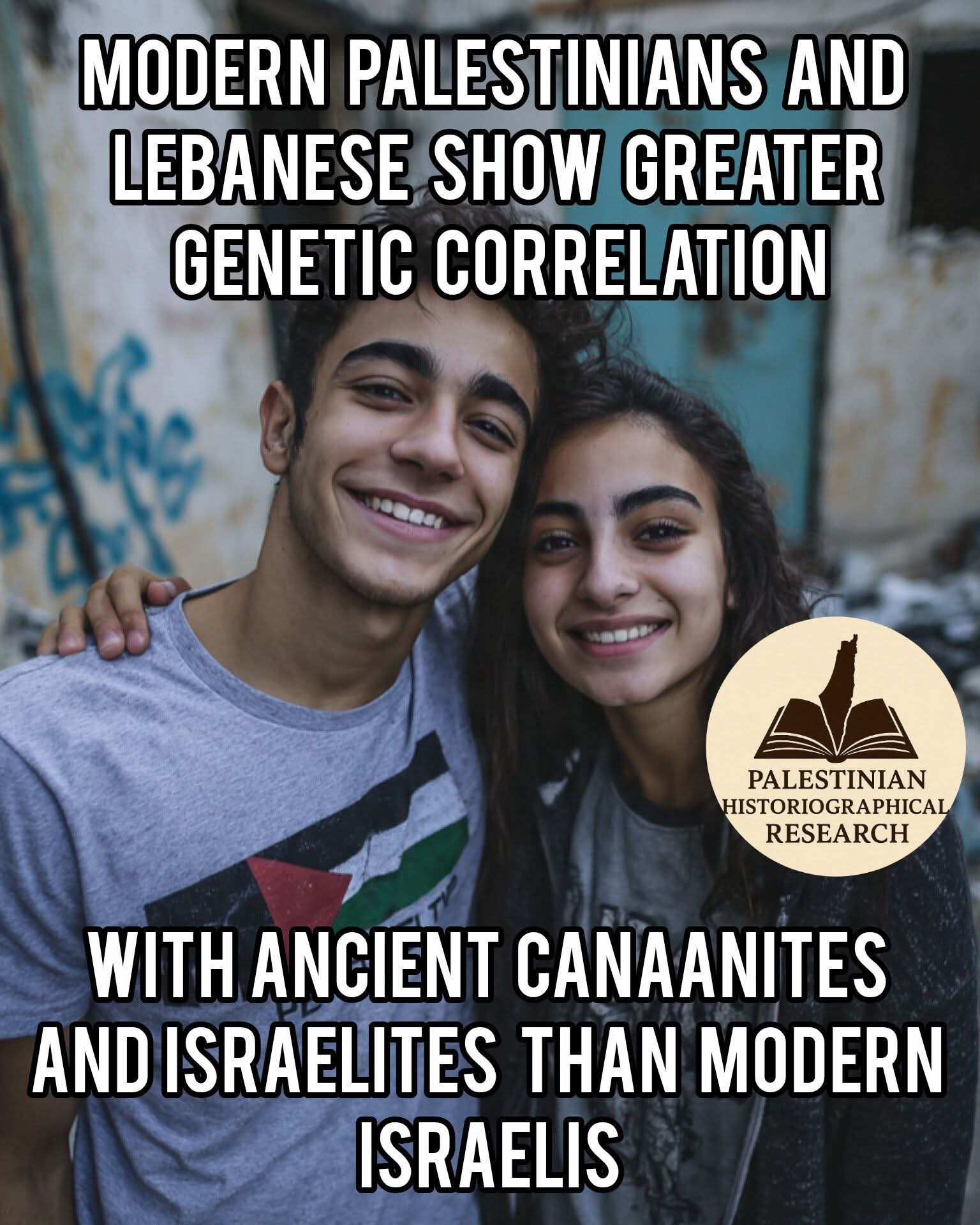
Several recent genetic studies show that modern Palestinians and Lebanese exhibit greater genetic continuity with ancient Levantine populations than the vast majority of contemporary Jewish Israelis. This finding contradicts the Zionist narrative that assumes a total population replacement in the region, revealing instead a significant genetic persistence from antiquity to the present. This genetic continuity—particularly with Canaanites and historical Levantine populations—has been maintained despite successive cultural, religious, and political transformations, positioning present-day Palestinians and Lebanese as the principal direct descendants of the ancestral populations of the Levant.
1. Genetic Continuity in Contemporary Palestinian and Lebanese Populations
Genomic studies have documented that modern Palestinians and Lebanese maintain a strong genetic relationship with ancient Levantine populations, such as Canaanites, Samaritans, Roman provincials, Byzantines, and early Islamized Arabs (Haber et al., 2017; Agranat-Tamir et al., 2020). This continuity is explained by the absence of large-scale population displacements during key events in regional history, which allowed for the gradual cultural integration of local communities.
One of the most representative studies, published in Cell (Agranat-Tamir et al., 2020), indicates that both Palestinians and Lebanese share a significant portion of their DNA with Canaanite remains found in Sidon and other sites, implying continuity since the Bronze Age. Another article in the American Journal of Human Genetics (Haber et al., 2017) reinforces this idea, showing that the Canaanites did not disappear but instead mixed with incoming groups whose descendants still inhabit the region today.
Subsequent quantitative analyses confirm high levels of continuity: Palestinians and Lebanese derive between 81–93% of their ancestry from populations related to the Bronze Age Levant (Canaanites), with smaller dilutions from East African (\~8–12%) or European (\~5–10%) components (Agranat-Tamir et al., 2020; Permana, 2026). Recent models indicate that Palestinians exhibit >90% contribution from Iron Age Levantines, clustering closely with ancient Canaanite and Israelite samples (Permana, 2026). Moreover, the process of Islamization and Arabization after the seventh century did not involve population replacement, but rather a religious and linguistic transformation of the same local communities, many of which had been Christian or Jewish before converting to Islam (Haber et al., 2016).
2. Diversity and Origins of Modern Jewish Israelis
The contemporary Jewish Israeli population originates primarily from the diaspora, including Ashkenazi Jews (Central and Eastern Europe), Sephardic Jews (the Iberian Peninsula and later North Africa/Ottoman Empire), and Mizrahi Jews (the Middle East and Central Asia). Each of these groups presents distinct genetic profiles due to admixture with local populations in the regions where they lived for centuries.
Ashkenazi Jews, who have historically occupied key positions in Israeli public life, show a high proportion of European ancestry (generally 40–60%), although they retain a residual Levantine component (Behar et al., 2010; Ostrer & Skorecki, 2013). In contrast, Mizrahi and Sephardic Jews, with origins closer to the Middle East, show greater genetic proximity to ancient Levantine populations. However, many of them migrated to Israel only in the twentieth century and therefore are not considered native populations of the region according to modern science.
Detailed analyses reveal that the weighted average of the modern Jewish Israeli population (with \~45% Ashkenazim, contributing significant European dilution) results in Levantine continuity below 60–70%. This contrasts with the 81–93% observed in Palestinians and Lebanese, where external dilution is lower (Agranat-Tamir et al., 2020; Permana, 2026; Khan, 2023). This diversity demonstrates that the notion of a “return” to the biblical territory is an ideological fallacy, as diaspora Jews were shaped by historical processes in highly diverse geographical contexts.
3. Conclusion
The available genetic evidence, including recent quantitative analyses, supports the conclusion that Palestinians and Lebanese maintain greater genetic continuity (>80–93%) with the ancestral populations of the Levant—including Canaanites and Israelites—than the average modern Jewish Israeli population, which is affected by European admixture in significant subgroups such as the Ashkenazim (Agranat-Tamir et al., 2020; Permana, 2026; Khan, 2023). This challenges certain essentialist interpretations of history and territorial rights and highlights the complexity of identity and belonging in a region shaped by millennia of cultural, religious, and political transformations.
References
- Agranat-Tamir, L., Waldman, S., Martin, M. A. S., Gokhman, D., Mishol, N., Eshel, T., … & Reich, D. (2020). The genomic history of the Bronze Age southern Levant. Cell, 181(5), 1146–1157.e11.
- Behar, D. M., Yunusbayev, B., Metspalu, M., et al. (2010). The genome-wide structure of the Jewish people. Nature, 466(7303), 238–242.
- Haber, M., Doumet-Serhal, C., Scheib, C. L., Xue, Y., Danecek, P., Mezzavilla, M., … & Tyler-Smith, C. (2017). Continuity and admixture in the last five millennia of Levantine history from ancient Canaanite and present-day Lebanese genome sequences. American Journal of Human Genetics, 101(2), 274–282.
- Haber, M., Mezzavilla, M., Xue, Y., & Tyler-Smith, C. (2016). Ancient DNA and the rewriting of human history: Be sparing with Occam’s razor. Genome Biology, 17(1), 1–6.
- Khan, R. (2023, December 28). More than kin, less than kind: Jews and Palestinians as Canaanite cousins. Razib Khan’s Unsupervised Learning.
- Permana, B. (2026). Genetic proximity of modern Palestinians and Ashkenazi Jews to Iron Age Levantines: A quantitative paleogenomic analysis.
- Ostrer, H., & Skorecki, K. (2013). The population genetics of the Jewish people. Human Genetics, 132(2), 119–127. (DOI link)







One Comment
I have been documenting this for years – please see
https://www.onepalestine.land/israel-palestine-explained/#not-descendants-of-the-israelites