1. Introduction: Dismantling the Dominant Narrative
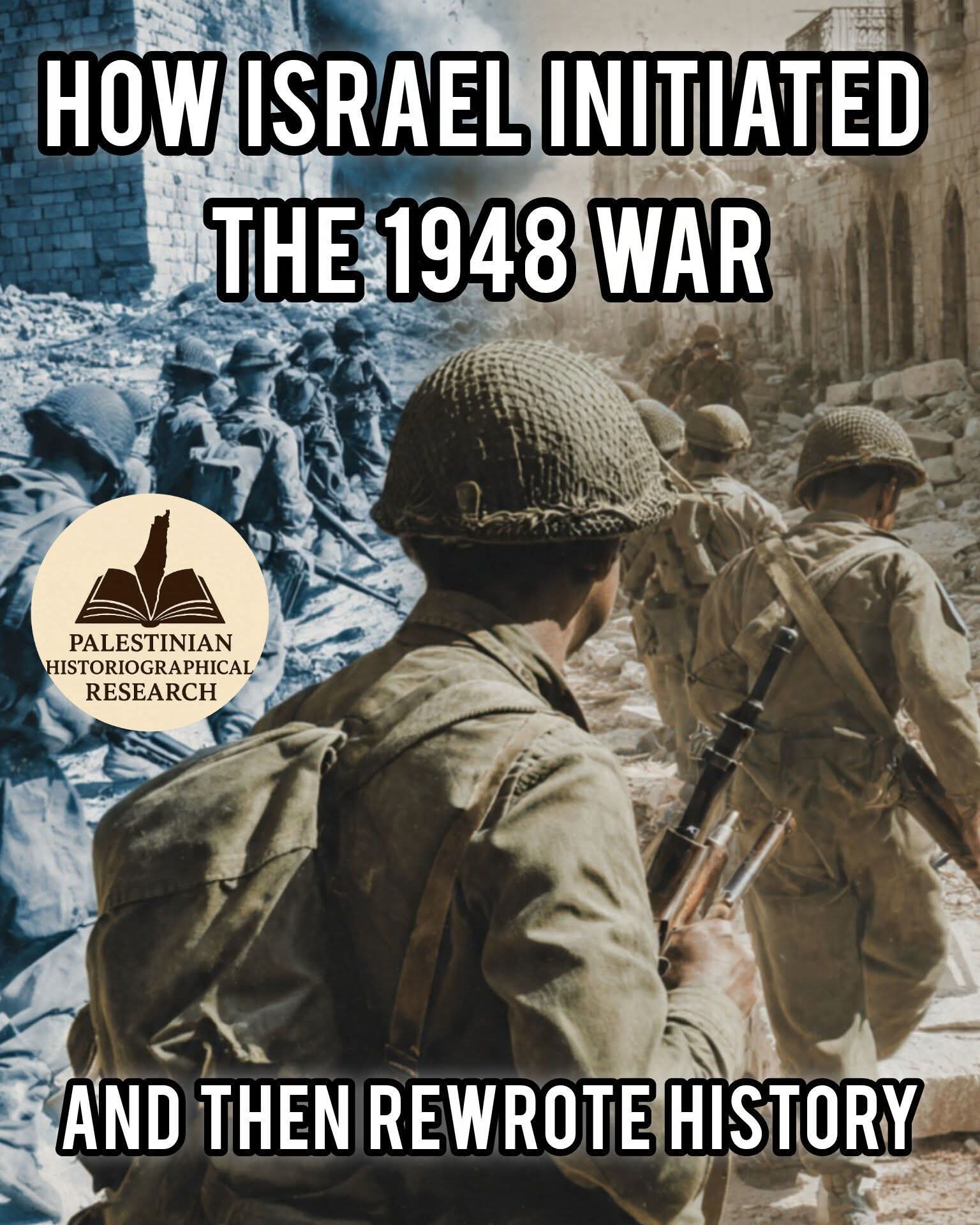
For more than seven decades, the official version of the 1948 war has been repeated like a mantra: on May 15, 1948, five Arab armies invaded the newly born State of Israel with the intention of “throwing the Jews into the sea.” This narrative, promoted by Israeli governments, Western media, and textbooks, presents Israel as an unarmed David facing a unified Arab Goliath. It is rarely mentioned that, by that time, 250,000 Palestinians had already been displaced by Zionist operations of a terrorist nature, initiated at least five months earlier (December 1947), and that the supposed unity of the Arab countries was more declarative than material.
Declassified documents from the Haganah (HA 105/93), the Israel Defense Forces (IDF), and the Red Cross reveal that the war did not begin with Arab tanks, but with a systematic ethnic cleansing aimed at granting the European Jewish minority demographic control over most of Palestinian territory. All of this was framed, beginning in March 1948, in Plan Dalet: a plan to occupy villages, destroy homes, and expel populations. This is the history that propaganda silences, but that academic historiography has recovered.
This article is not an opinion. It is a reconstruction based on declassified primary documents, testimonies of participants, and rigorous historiographical analysis. What emerges is a clear chronology: the war did not begin with Arab armies crossing borders, but with Zionist operations that, from December 1947 onward, emptied villages, destroyed homes, and triggered a mass exodus. Only then, and in a disorganized manner, did Arab armies intervene. And not all with the same intentions.
2. The Zionist Militias: Protagonists Before the War (1946–1948)
Before talking about the Arab armies, it is necessary to talk about who fired first, who occupied first, and who expelled first.
2.1 Haganah, Irgun, and Lehi: Non-Defensive Forces
The Haganah—the official armed wing of the Yishuv—presented itself as a defensive militia. But its actions since 1946 reveal the opposite. The bombing of the King David Hotel (July 22, 1946) was not a mistake: it was an operation approved by the Zionist high command (approved by David Ben-Gurion, according to the minutes of Committee X, July 12, 1946 – HA 80/50). Ninety-one people were killed, including Britons, Arabs, and Jews.
Menachem Begin, leader of the Irgun, justified it in his memoirs: “It was necessary to show the world that we would no longer accept the British mandate. The attack was a political success” (Begin, 1951, p. 212).
The Irgun and Lehi—dissident groups—were not marginal. They operated with the knowledge and, at times, the coordination of the Haganah. Between 1946 and 1948 they carried out more than 200 terrorist attacks against Arab, British, and dissident Jewish targets (Segev, 1999, p. 478).
2.2 Plan Dalet: The Design of Ethnic Cleansing
On March 10, 1948, the Haganah drafted Plan Dalet (Haganah Archive, HA 68/1). It was not a defensive plan. It was a plan for territorial and demographic occupation. The original document states: “Operations against villages located within or outside our borders that resist or may resist: a) Destruction of the village (fire, explosives, mines). b) Expulsion of the population beyond the borders of the State. c) In the event of armed resistance, elimination of the hostile force and expulsion of the population” (Plan Dalet, clauses 3b–3c, cited in Pappé, 2006, p. 88).
Yigal Allon, commander of the Palmach, explained years later: “We did not wait to be attacked. We took the initiative: we surrounded the village, gave 15 minutes to evacuate with loudspeakers, and then entered. If there was resistance, we crushed it” (Allon, 1970, p. 121).
This was not a secret plan. It was distributed to all brigade commanders.
2.3 Ethnic Cleansing Before Independence: The Chronology of Terror
From December 1947 onward, Zionist operations were not reprisals: they were systematic occupations. Benny Morris (2004) documents 75 major operations before May 15. The most significant include:
- December 1947 – February 1948: the silent beginning. Sa’sa (February 14, 1948): the Palmach dynamited 60 houses. Eleven dead. Testimony of a soldier: “We entered at night, placed explosives in the houses. There was no combat” (Morris, 2004, p. 76). Twenty-two coastal and Galilee villages: approximately 50,000 refugees. Haganah report: “The population flees before we arrive” (HA 105/93).
- April 9, 1948: Deir Yassin – the turning point. The Irgun and Lehi entered the neutral village of Deir Yassin. Jacques de Reynier, delegate of the Red Cross, described a deliberate massacre with mutilated bodies, women and children killed, estimating up to 250 victims; Benny Morris, after reviewing Israeli documents, confirms at least 109–110 civilian deaths, many by bayonet (Red Cross Archive, April 11, 1948, cited in Morris, 2004, p. 237). The Haganah itself intentionally spread the news of Deir Yassin via loudspeakers and radio to accelerate panic and mass exodus in other areas: “Deir Yassin! Deir Yassin!” (Morris, 2004, p. 239). Result: mass panic. Within 48 hours, 60,000 Arabs fled Haifa without fighting (HA 105/257).
- April 1948: Operation Nachshon. Eighteen villages between Jerusalem and Tel Aviv. Seventy thousand displaced. Testimony of Yitzhak Rabin (censored in 1979, leaked by The New York Times in October 1979): “We ordered everyone to evacuate. There was no alternative” (Rabin, 1979, p. 56).
- May 1948: Lydda and Ramla. Although technically after May 14, the order was given earlier. Ben-Gurion wrote in his diary (July 15, 1948): “Expel them. Do not leave anyone behind” (Ben-Gurion Diary, Ben-Gurion Archive). Seventy thousand people were expelled in 48 hours. Women, children, and the elderly walked under the sun toward Ramallah. Dozens died of thirst.
3. History as Propaganda vs. Scientific Historiography: The Official Narrative Confronted with Archival Analysis
Until the late 1970s, the history of the 1948 war was written as state propaganda: with closed archives, no access to primary documents, and in the service of national legitimization. Following the partial opening of the Haganah and IDF archives under legislative pressure, a group of Israeli historians—known as the “new historians”—began a scientific historiography based on direct analysis of declassified primary sources: brigade reports, war diaries, diplomatic cables, and internal documents. What they found was not a desperate defensive war, but a planned campaign of territorial and demographic control.
3.1 History as State Propaganda
Official historians wrote without primary documents, and their works functioned as tools of national education and state legitimization.
Anita Shapira: “Zionist violence was a tragic but inevitable response to Arab aggression. Israel fought for its existence” (Shapira, 1992, p. 571). Shapira never mentions Plan Dalet or Deir Yassin as a deliberate psychological operation, nor the mass exodus prior to May 15. Her book was a mandatory school text until the 1990s.
Netanel Lorch: “The Arabs fled on orders from their leaders. There were no expulsions” (Lorch, 1961, p. 89). Without citing a single primary source. This claim is contradicted by dozens of internal Haganah reports documenting forced evacuations (Morris, 2004, p. 256).
Shabtai Teveth: “Ben-Gurion never ordered expulsions. Everything was a consequence of the war” (Teveth, 1985, p. 189). He ignores numerous entries in Ben-Gurion’s diary between 1947 and 1948 that explicitly speak of “transfer,” “expulsion,” and “cleansing.”
Ben-Zion Dinur: “History must educate the youth in the spirit of realized Zionism” (Dinur, 1955).
3.2 Scientific Historiography: The New Historians
The new historians examined declassified Israeli archives directly and applied scientific methods: rigorous documentary analysis, triangulation of sources, and rejection of unverified narratives.
Benny Morris: In The Birth of the Palestinian Refugee Problem Revisited (2004), Morris reviewed thousands of documents from the Haganah and IDF archives. His conclusion is clear: “There was no explicit central order for a general expulsion, but there was a systematic pattern of military operations that resulted in the depopulation of hundreds of villages. The Zionist leadership accepted, and even encouraged, this outcome in order to create a state with an overwhelming Jewish majority” (Morris, 2004, pp. 588–589). Morris documents at least 24 operations involving direct expulsions before May 15 and estimates between 200,000 and 300,000 Palestinians displaced in that phase (Morris, 2004, p. 262). Although he evolved politically in later years, his 2004 archival work remains the most solid quantitative reference.
Ilan Pappé: In The Ethnic Cleansing of Palestine (2006), Pappé characterizes Plan Dalet as a master plan of ethnic cleansing and analyzes specific written orders: “In Operation ‘Broom’ (May 1948), the order was: ‘Clean the area of all Arabs.’ This was not about defense, but about creating irreversible demographic facts before independence” (Pappé, 2006, p. 131). Pappé documents the destruction or depopulation of 418 villages, 70% of them before May 15 (Pappé, 2006, pp. 198–200).
Avi Shlaim: In The Iron Wall (2001), Shlaim reconstructs the diplomatic dimension using British archives and internal memoirs: “On May 11, 1948, four days before Israel’s declaration, Golda Meir flew to Amman disguised as an Arab. Abdullah told her: ‘I will not attack the Jewish state, but I cannot control the other Arabs.’ The pact was clear: Transjordan would take the West Bank, Israel the rest” (Shlaim, 2001, p. 31). This dismantles the idea of a unified Arab war of extermination.
Tom Segev and Simha Flapan: Segev (1949: The First Israelis, 1986) documents internal censorship and the deliberate destruction of Palestinian memory. Flapan (The Birth of Israel: Myths and Realities, 1987) summarizes: “The myth of the defensive war is the foundation of Israeli identity. Without it, the state loses its moral justification” (Flapan, 1987, p. 12).
3.3 Refuting Persistent Myths: Common Counterarguments and Their Collapse in the Face of Evidence
The official narrative and its defenders repeat predictable objections that do not withstand documentary analysis.
- “The Arabs rejected Resolution 181 and initiated the violence.” The rejection was predictable in the face of a partition that granted 55–56% of the territory to a minority that owned less than 7% of the private land (Morris, 2004; Khalidi, 2020). But systematic Zionist operations began years earlier and intensified after the resolution. It was not a defensive response, but a planned initiative.
- “There was no central plan of expulsion; everything was an inevitable consequence of war.” The literal text of Plan Dalet refutes this claim: “Destruction of villages… Expulsion of the population beyond the borders of the State” (Plan Dalet, cited in Pappé, 2006, p. 88; Morris, 2004, p. 589). Morris confirms a “systematic pattern” encouraged by the leadership (Morris, 2004, pp. 588–589).
- “The new historians are biased revisionists or anti-Israeli.” Their conclusions derive exclusively from declassified Israeli archives, not from external sources. Even Morris, after his later political shift, has left his archival analysis intact.
- “The Arab intervention of May 15 was a coordinated invasion of extermination.” It was a late and disorganized response to the already completed Palestinian collapse. Secret pacts with Abdullah (three documented meetings between 1947 and 1948) ensured that the Arab Legion would not attack assigned Jewish territory (Shlaim, 2001; Rogan & Shlaim, 2007).
These arguments are nothing more than attempts to perpetuate the foundational myth. Israeli archival evidence dismantles them one by one.
4. The Arab Intervention: Late, Fragmented, and Partially Complicit
On May 15, 1948, five Arab armies crossed the borders of Palestine. But it was not a coordinated invasion nor a crusade to destroy the nascent State of Israel. It was a desperate and disorganized response to the collapse of Palestinian society, already devastated by five months of Zionist operations.
4.1 Transjordan: Israel’s Secret Ally
The key actor was Transjordan, commanded by King Abdullah and his Arab Legion, trained and financed by Great Britain. Avi Shlaim (2001) documents three secret meetings with Zionist leaders:
- November 17, 1947 (immediately after Resolution 181): Golda Meir meets Abdullah in Naharayim. They agree on a functional division of Palestine: Transjordan would take the Arab zone assigned by the UN, Israel the Jewish zone (FO 800/487).
- February 1948: Abdullah reaffirms: “My forces will not enter Jewish territory. Only the area assigned to the Arabs” (Shlaim, 2001, p. 28).
- May 11, 1948: Meir flies to Amman in disguise. Abdullah, under pressure from the Arab League, says: “I cannot control the other Arabs, but I will not fight you” (Meir, 1973, pp. 214–216).
Military result: the Jordanian Arab Legion—the best equipped, with 8,000 men—never attacked Tel Aviv, Haifa, or the Negev. It limited itself to Jerusalem and the West Bank. British Colonel John Glubb wrote: “Our mission was to occupy the Arab zone, not to destroy the Jewish state. We had strict orders not to cross the partition lines” (Glubb, 1957, p. 98).
4.2 Other Armies: Chaos, Limitations, and Particular Objectives
–Egypt: sent 10,000 poorly trained men. King Farouk acted under internal pressure. He bombed Tel Aviv on May 15, but his advance was halted at Ashdod. Objective: prevent Israel from taking the Negev and block expansion toward Sinai (Rogan and Shlaim, 2007, p. 67).
–Syria and Lebanon: local attacks in Galilee with fewer than 3,000 men each. No coordination.
–Iraq: 3,000 soldiers under Jordanian command. Logistic function.
Total: fewer than 25,000 Arab soldiers, many inexperienced and poorly equipped, with divided command (Morris, 2004, p. 202). Azzam Pasha, secretary of the Arab League, spoke in May 1948 of a “war of extermination,” but this was rhetoric for internal consumption. As Farouk admitted in a 1949 interview: “We entered to save the Palestinians, not to destroy Israel. We had neither the men nor the plan” (cited in Rogan and Shlaim, 2007, p. 71).
In summary: the Arab intervention was reactive to the Palestinian collapse, not the cause of the conflict. In the case of Transjordan, it was partially complicit in the final outcome.
5. Coexistence Broken by Zionist Colonialism
For centuries, Jews, Muslims, and Christians lived in Palestine under the Ottoman Empire without structural conflicts, in a relatively well-documented coexistence. The rabbi of Jerusalem, Yaakov Meir, wrote in 1896: “We live in peace with our Arab neighbors. There is no hatred or enmity. We share markets, weddings, and funerals” (Segev, 1999, p. 34).
The Balfour Declaration (1917) promised a “Jewish national home” in a territory where Jews were 8% of the population. Between 1882 and 1947, 450,000 European immigrants arrived under the British mandate. Land was purchased, but with clauses that expelled Arab tenants. As Edward Said wrote in Orientalism (1979): “Zionism did not see Arabs as a people with rights, but as a demographic obstacle that had to be eliminated” (Said, 1979, p. 69).
Rosemary Sayigh (Palestinians: From Peasants to Revolutionaries, 1997) collects oral testimonies: “Before 1948 we shared bread, water, and celebrations. Afterward we became enemies because someone decided that this land was only for one” (Sayigh, 1997, p. 45).
6. Rewriting the Narrative: The Power of Official Memory
–After the war, Israel controlled the archives, education, and memory.
–1955–1978: the Haganah and IDF archives were closed for “national security.”
–1957: Yitzhak Rabin’s diary on the expulsion of Lydda was censored.
–1967: after the occupation of East Jerusalem, Ottoman and Jordanian archives with Palestinian property records were destroyed (Segev, 1986, p. 47).
After the war, the Israeli state carried out a deliberate policy of Hebraization of the names of destroyed villages and of planting forests over their ruins, directed by official committees from 1948–1949, with the explicit objective of erasing the Palestinian presence from the landscape (Segev, 1986; Benvenisti, 2000).
School curricula: the books by Lorch and Shapira taught that “the Arabs fled of their own free will.”
The myth of the “defensive war” became national dogma. But the new historians broke the monopoly.
As Simha Flapan wrote (1987): “The myth of the War of Independence is the foundation of Israeli identity. Without it, the state loses its moral justification before the world” (Flapan, 1987, p. 12).
7. Conclusion: The Truth Behind the Myth
The 1948 war did not begin on May 15. It began in December 1947, with Zionist operations that massacred and emptied villages, caused panic, and destroyed a constituted society. The exodus of 700,000 Palestinians was not an accident: it was the demographic objective of Plan Dalet. The Arab intervention came late, divided, and was in part complicit.
Critical historiography does not seek to assign blame, but to understand facts. Only when real responsibilities—and not myths—are recognized will it be possible to build a just peace. Because as long as part of the world continues to believe that Israel was born defending its existence, rather than expanding its territory at the expense of another people, reconciliation will not be possible.
References
- Allon, Y. (1970). The Making of Israel’s Army. Vallentine Mitchell.
- Begin, M. (1951). The Revolt. Nash Publishing.
- Benvenisti, M. (2000). Sacred Landscape: The Buried History of the Holy Land Since 1948. University of California Press.
- Flapan, S. (1987). The Birth of Israel: Myths and Realities. Pantheon Books.
- Glubb, J. B. (1957). A Soldier with the Arabs. Hodder & Stoughton.
- Khalidi, R. (2020). The Hundred Years’ War on Palestine: A History of Settler Colonialism and Resistance, 1917–2017. Metropolitan Books.
- Meir, G. (1973). My Life. G. P. Putnam’s Sons.
- Morris, B. (2004). The Birth of the Palestinian Refugee Problem Revisited (2nd ed.). Cambridge University Press.
- Pappé, I. (2006). The Ethnic Cleansing of Palestine. Oneworld Publications.
- Rabin, Y. (1979). The Rabin Memoirs.
Related Posts