Introduction
The history of Palestinian Christians who remained inside the borders of Israel after 1948 is not a story of successful integration or normal continuity. It is the history of a population that managed to stay on its land physically while losing much of it legally. During the 1948 Nakba, most Palestinians—Muslims and Christians alike—were expelled or forced to flee. A smaller number remained within the new state, but their presence did not protect them from a sweeping system of land confiscation that permanently reshaped their relationship to their homeland.
Through laws such as the Absentees’ Property Law, Israel transferred millions of dunams of land from Palestinian ownership to the state and to Jewish national institutions. This process affected the vast majority of Arabs who remained inside Israel, including Christian communities that had lived on and cultivated their land for generations (Forman & Kedar, 2004; Masalha, 2012). At the same time, more than 530 Palestinian villages were destroyed during the war, many of them home to mixed Muslim and Christian populations, leaving lasting social and economic damage among the Christians who remained (Morris, 2004; Khalidi, 1992).
1. Palestinian Christians before 1948
Before the establishment of Israel, Palestinian Christians formed a socially influential and demographically significant part of Palestinian society under the British Mandate. In 1945 they made up roughly 7–9 percent of the total population, with particularly strong concentrations in Jerusalem, Haifa, Jaffa, Bethlehem, and Nazareth (Hadawi, 1970). The 1946 British census recorded about 145,000 Christians in Palestine—nearly 8 percent of the population, with significant urban representation (Kimmerling & Migdal, 2003).
These communities were deeply embedded in the economic, cultural, and political life of the country. They worked as farmers, merchants, professionals, educators, and journalists. Christian intellectuals played a key role in Arab nationalism through press and education networks, including influential newspapers such as Falastin (Kimmerling & Migdal, 2003).
2. 1948 and the survival of a Christian minority inside Israel
The 1948 war displaced around 750,000 Palestinians and destroyed more than 530 villages, transforming the region’s demographic and geographic structure (Morris, 2004; Masalha, 2012; Khalidi, 1992). Palestinian Christians were expelled alongside Muslim populations in many areas, though a minority remained inside the new Israeli state, particularly in Galilee and a few urban centers.
Approximately 34,000 Christians remained in Israel after 1948, forming a significant portion of the remaining Arab population (Kimmerling & Migdal, 2003). In some cities such as Nazareth, Christians largely remained, while in Haifa and Jaffa most were expelled (Morris, 2004).
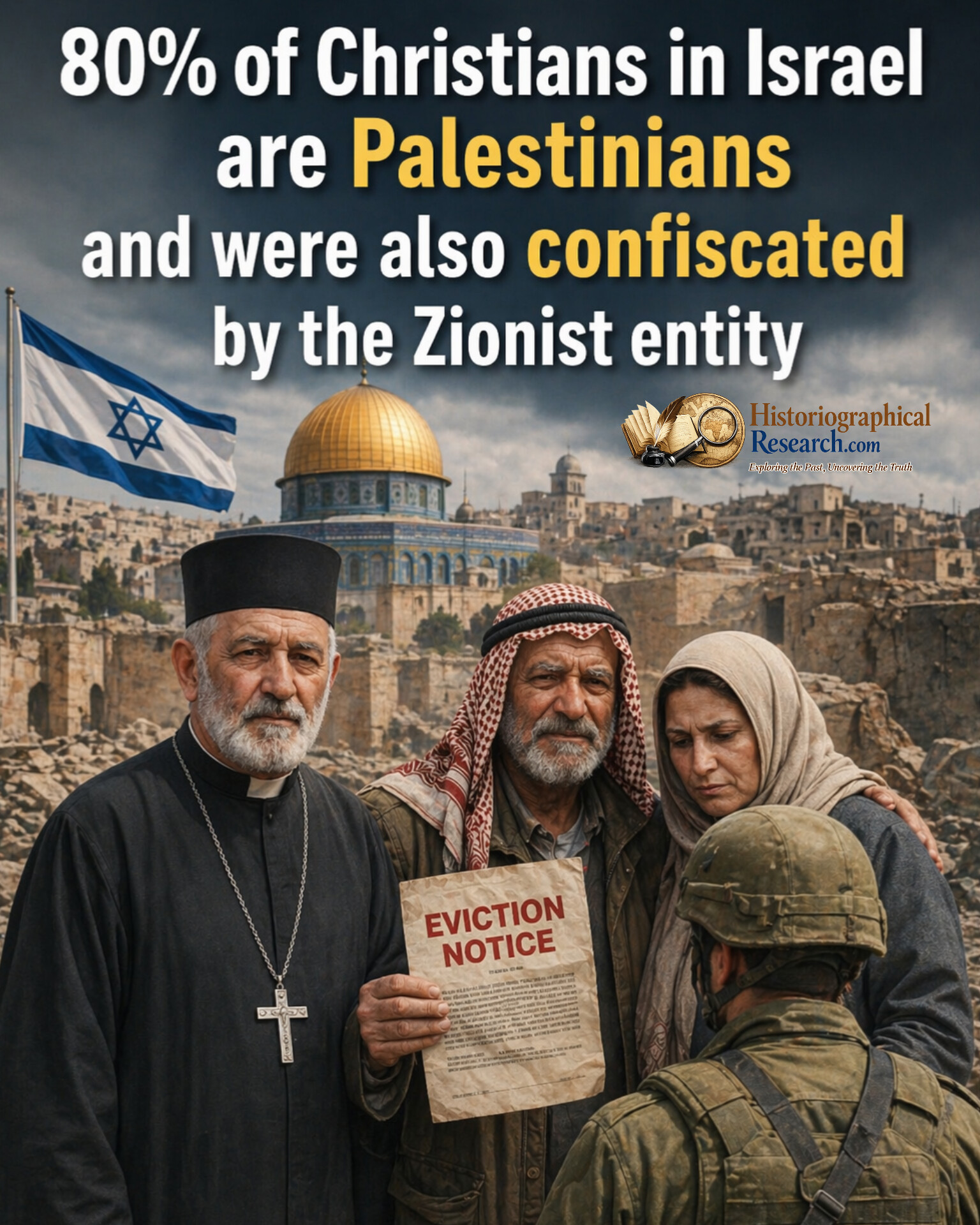
Today, approximately 80 percent of Christians in Israel are Arab Palestinians (Central Bureau of Statistics, 2024). Entire villages such as Iqrit and Kafr Bir’im were depopulated under temporary military orders and never returned to their inhabitants despite legal rulings (Masalha, 2012).
3. Legal framework of dispossession
3.1 Absentees’ Property Law
The Absentees’ Property Law (1950) allowed the Israeli state to confiscate property belonging to Palestinians who were not physically present during a defined period of the conflict, even if they were internally displaced within the state (Forman & Kedar, 2004). This enabled the transfer of vast tracts of land, including Christian-owned property, to state institutions.
3.2 “Present absentees”
The category of “present absentees” referred to Palestinians who remained within Israel but were legally classified as absent from their property. This legal mechanism resulted in large-scale confiscation of agricultural and urban land, particularly in Galilee (Forman & Kedar, 2004; Kimmerling & Migdal, 2003).
The case of Iqrit demonstrates the permanence of this system. Despite a 1951 Israeli Supreme Court ruling in favor of return, the village lands were never restored and were formally absorbed under state control (Masalha, 2012).
4. Demographic change and emigration
Palestinian Christians have experienced a long-term demographic decline due to land dispossession, economic marginalization, and emigration (Sabella, 2001). Their proportion of Israel’s Arab population has steadily decreased since 1948, despite continued historical presence in key regions (Central Bureau of Statistics, 2024).
Today, emigration remains a major factor in population decline, driven by limited economic opportunities and structural inequalities (Sabella, 2001).
Conclusion
Christians in Israel today are overwhelmingly indigenous Palestinians who remained after 1948 but experienced large-scale dispossession through legal and administrative mechanisms. Laws such as the Absentees’ Property Law and the category of “present absentees” enabled the systematic transfer of land ownership while maintaining physical residence in place.
The result has been demographic contraction, continued emigration, and the erosion of historic Christian communities in the region.
References
Central Bureau of Statistics. (2024). Christians in Israel: Christmas 2024. State of Israel.
Forman, G., & Kedar, A. (2004). From Arab land to “Israel lands”: The legal dispossession of the Palestinians displaced by Israel in the wake of 1948. Environment and Planning D: Society and Space, 22(6), 809–830.
Hadawi, S. (1970). Village statistics of 1945: A classification of land and area ownership in Palestine. PLO Research Center.
Khalidi, W. (Ed.). (1992). All that remains: The Palestinian villages occupied and depopulated by Israel in 1948. Institute for Palestine Studies.
Kimmerling, B., & Migdal, J. (2003). The Palestinian people: A history. Harvard University Press.
Masalha, N. (2012). The Palestine Nakba: Decolonising history, narrating the subaltern, reclaiming memory. Zed Books.
Morris, B. (2004). The birth of the Palestinian refugee problem revisited. Cambridge University Press.
Sabella, B. (2001). Palestinian Christians: Challenges and hopes. Bethlehem University Press.