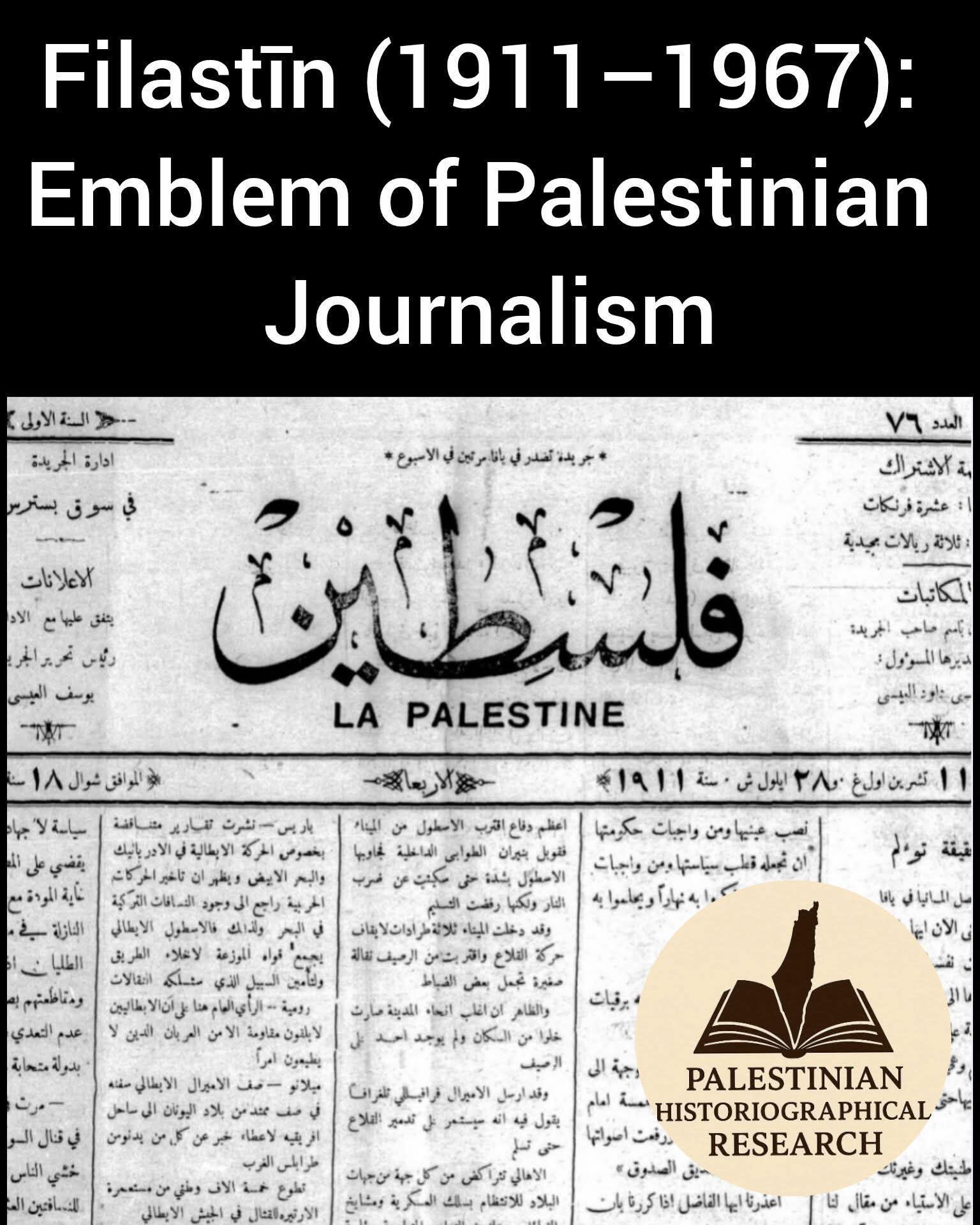
The newspaper Filastīn (فلسطين in Arabic, meaning “Palestine” in English) adopted this title in 1911 as an explicit declaration of territorial identity. From its first issue, the publication presented itself as a voice for Palestine and for the Palestinians, in a context marked by the emergence of Arab nationalism and growing tensions surrounding sovereignty over the land (Kabha, 2007; Beška & Foster, 2021).
1. Founding and Early Years (1911–1914): Emergence of an Anti-Colonial Voice and the Genesis of the Term “Filastīnī”
In late Ottoman Palestine, Jaffa constituted a dynamic urban center: a key commercial port, a diverse population, and an intellectual hub nourished by the Arab Nahda. The Young Turk Revolution (1908) loosened press restrictions and facilitated the emergence of numerous Arabic newspapers in the region. Within this context, ʿĪsā al-ʿĪsā and his cousin Yūsuf al-ʿĪsā, Orthodox Christians belonging to a family with ties in Lebanon and Palestine, founded Filastīn on January 15, 1911, as a biweekly paper. Equipped with their own printing press, they quickly reached more than 1,100 subscribers (Ayalon, 1995; Khalaf, 2009; Bracy, 2011).
In its initial stage, the newspaper focused on educational, social, and ecclesiastical reforms—particularly the Arabization of the Patriarchate of Jerusalem in opposition to Greek dominance—but soon moved toward broader political interventions. It published local reports that reinforced a sense of shared territorial community (Dierauff, 2021; Tamari, 2014). Notably, it made pioneering use of the term “filastīnī” (Palestinian), which appeared in at least 57 articles between 1911 and 1914 to designate the Arabs of the region as a collective defined by territory, the Arabic language, and shared heritage. In doing so, it both reflected and contributed to differentiating Palestine within Bilād al-Shām, capturing the emerging foundations of a modern national consciousness (Beška & Foster, 2021; Khalidi, 1997; Masalha, 2018).
Regarding Zionism, its coverage evolved from initial observations about possible agricultural contributions to a systematic critique grounded in concrete evidence: large-scale land acquisitions by the Jewish National Fund, labor exclusivism in colonies, and agrarian conflicts such as that of Zarnūqa (1913). Zionism was framed as a settler-colonial project with intentions of exclusivism and displacement of the native inhabitants, reflecting real concerns about indigenous sovereignty (Beška, 2016; Pappé, 2015). It also covered the Beilis affair (1913), condemning Russian antisemitism while clearly distinguishing between integrated Palestinian Jews and Zionist settlers, reflecting a nuanced and progressive approach (Beška, 2014). These positions led to suspensions by Ottoman authorities but consolidated its role within the emerging public sphere (Tamari, 2017; Muslih, 1990).
2. British Mandate and Discursive Consolidation (1920–1935): Platform of the Public Sphere and Media Resistance
The establishment of the British Mandate (1920) and the facilitation of Zionist immigration through the Balfour Declaration prompted Filastīn to resume publication in 1921. It consolidated itself as the most influential Arabic daily in Palestine, with print runs of up to 3,000 copies and more than 1,100 subscribers by 1929 (Ayalon, 1995; Najjar, 1975). It interacted with Arab national congresses, the disturbances of 1920–1921, and debates within the Supreme Muslim Council, articulating demands for independence and providing space for voices from both elites and peasant sectors (Manna, 1995; Kabha, 2007).
The newspaper actively reflected the construction of modern Palestinian identity, integrating administrative, educational, and media factors to capture an inclusive nationalism encompassing Muslims, Christians, and Druze in the face of Zionism and the Mandate regime (Khalidi, 1997; Pappé, 2015; Foster, 2014). It introduced front-page political cartoons satirizing British and Zionist policies, reaching illiterate audiences through collective readings in cafés and markets. In 1929 it launched a weekly English-language edition to internationalize the Palestinian cause, particularly after the Western Wall disturbances (Bracy, 2011; Tamari, 2017). Despite more than 20 suspensions under British censorship, it maintained critical coverage of events such as the London Conference (1930) and denounced colonial complicity (Najjar, 1975; Khalidi, 1981; AlGhussein, 2020).
3. The Great Revolt and Political Radicalization (1936–1939): Voice of the Insurgency and National Unity
The Great Arab Revolt (1936–1939) emerged in response to accelerated Zionist immigration and British repression; by 1936, Zionists controlled approximately 6 percent of cultivable land. Filastīn supported the six-month general strike, the rural insurgency, and demands for sovereignty, incorporating testimonies from fellahin and documenting colonial repression (Najjar, 1975; W. Khalidi, 1987; Kabha, 2003). It presented the revolt as the culmination of a coherent anti-colonial trajectory, using cartoons to criticize internal divisions (between the Husaynis and the Nashashibis) and to promote the unity of the “umma filastiniyya” (Morris, 2001; Pappé, 2015; Kabha, 2003). Its coverage preserved the collective memory of the insurgency despite recurrent suspensions (Foster, 2014; Masalha, 2018).
4. 1948 and Continuity in East Jerusalem (1948–1967): Resilience, Memory, and Historiographical Archive
The Nakba of 1948 led to the expulsion of 750,000 Palestinians and the incorporation of Jaffa into Israel. The editorial offices of Filastīn relocated to East Jerusalem (under Jordanian control), resumed publication in 1950, and continued until February 1967. Directed by Raja al-ʿĪsā (the founder’s son) and edited by Yusuf Hanna, the newspaper maintained a nationalist focus despite Jordanian censorship, which promoted integration into the Hashemite Kingdom and limited direct criticism of the regime or of the annexation of the West Bank (1950).
During this stage, Filastīn focused on preserving Palestinian memory and documenting the post-Nakba reality: it published reports on the lives of refugees in camps in the West Bank and Jordan, their socioeconomic conditions, the right of return, and testimonies that kept alive the collective narrative of the 1948 catastrophe. It covered themes of cultural resistance, education, literature, and Arab-Palestinian poetry, emphasizing historical continuity and the “sumud” (steadfastness) of Palestinians under territorial fragmentation. It included reports on daily life in East Jerusalem, Haifa, and the Galilee, denouncing discriminatory laws in Israel and border incidents, albeit in a more moderate tone to avoid closure. It also reflected pan-Arab aspirations (such as Nasserism) that fueled hope for liberation.
In 1967, a Jordanian press law mandated its merger with Al-Manar, giving rise to Ad-Dustour (whose first issue appeared on March 28, 1967, before the Six-Day War and the Israeli occupation). The new daily relocated to Amman and inherited part of the nationalist legacy of Filastīn. During its East Jerusalem period, the newspaper played a decisive role in preserving threatened Palestinian identity (Masalha, 2012; Manna, 2022; Tamari, 2017). Its archive from those years constitutes an essential primary source for tracing the continuity of Palestinian political discourse from the end of the Ottoman period (Khalidi, 1981; Masalha, 2018; Bracy, 2011).
Conclusion
The trajectory of Filastīn exemplifies how the Palestinian Arab press reflected and amplified the historical realities of a society in transformation, adapting its discourse to successive conjunctures of Ottoman rule, British Mandate, revolt, Nakba, and Jordanian administration. From its reformist founding in 1911 to its closure in 1967, it captured the emergence of Palestinian nationalism: pioneering in popularizing “filastīnī” as a territorial identity, incisive in denouncing Zionism as a settler-colonial project with intentions of exclusivism and displacement of the native inhabitants, and resilient in defending inclusive unity and sovereignty. Particularly in the post-1948 period, under Jordanian censorship, its coverage of refugees, memory of the Nakba, cultural resistance, and aspirations of return reflected a differentiated Palestinian narrative in the face of attempts at forced integration or denial. Its archive—spanning from the Ottoman twilight to the eve of the 1967 occupation—represents one of the most valuable documentary sources for understanding the emergence, resilience, and continuity of Palestinian identity in contexts of dispossession and fragmentation. In contemporary critical historiography, Filastīn emerges as an indispensable testimony to how the mediated public sphere captured a coherent and resistant national narrative grounded in existing territorial and social realities (Khalidi, 1997; Pappé, 2015; Kabha, 2007; Beška & Foster, 2021; Masalha, 2018).
Bibliography
- AlGhussein, W. (2020). The role of the nationalist press in reporting Zionist land expropriation and labor conquest in Palestine during the Mandate period (Doctoral dissertation). City University of New York. (download PDF)
- Ayalon, Y. (1995). The press in the Arab Middle East: A history. Oxford University Press.
- Beška, E. (2014). “The disgrace of the twentieth century”: The Beilis affair in Filastin newspaper. Jerusalem Quarterly, 58, 93–108. (read online)
- Beška, E. (2016). From ambivalence to hostility: The Arabic newspaper Filastin and Zionism, 1911–1914. Slovak Academic Press. (download PDF)
- Beška, E., & Foster, Z. J. (2021). The origins of the term “Palestinian” (“Filasṭīnī”) in late Ottoman Palestine, 1898–1914. Academia Letters, Article 1884. (download PDF)
- Bracy, R. M. (2011). Printing class: ‘Isa al-‘Isa, Filastin, and the textual construction of national identity, 1911–1931. University Press of America.
- Dierauff, E. (2021). Translating late Ottoman modernity in Palestine: The origins of the term filastīnī in the newspaper Filastin. Jerusalem Quarterly, 85, 6–25. (read online)
- Foster, Z. J. (2014). The emergence of a Palestinian national identity: A theory-driven approach. Michigan Journal of History, 11(1), 1–22. (download PDF)
- Kabha, M. (2003). The Palestinian press and the general strike, April–October 1936: Filastin as a case study. Middle Eastern Studies, 39(3), 169–189.
- Kabha, M. (2007). The Palestinian press as shaper of public opinion 1929–39: Writing up a storm. Vallentine Mitchell.
- Khalaf, N. T. (2009). Les mémoires de ‘Issa al-‘Issa: Journaliste et intellectuel palestinien (1878–1950). Karthala.
- Khalidi, R. (1997). Palestinian identity: The construction of modern national consciousness. Columbia University Press. (download PDF)
- Khalidi, T. (1981). Palestinian historiography: 1900–1948. Journal of Palestine Studies, 10(3), 59–76.
- Khalidi, W. (1987). Before their diaspora: A photographic history of the Palestinians, 1876–1948. Institute for Palestine Studies. (view on Archive.org)
- Manna, A. (1995). A’lam Filastin fi awakhir al-’ahd al-’uthmani (1800–1918) [The Palestinian elites in the late Ottoman period]. Institute for Palestine Studies.
- Manna, A. (2022). Nakba and survival: The story of Palestinians who remained in Haifa and the Galilee, 1948–1956. University of California Press. (download PDF)
- Masalha, N. (2012). The Palestine Nakba: Decolonising history, narrating the subaltern, reclaiming memory. Zed Books. (read online)
- Masalha, N. (2018). Palestine: A four thousand year history. Zed Books. (download PDF)
- Morris, B. (2001). Righteous victims: A history of the Zionist-Arab conflict, 1881–2001. Vintage. (view on Archive.org)
- Muslih, M. Y. (1990). The origins of Palestinian nationalism. Columbia University Press. (download PDF)
- Najjar, A. A. (1975). The Arabic press and nationalism in Palestine, 1920–1948 (Doctoral dissertation). Syracuse University.
- Pappé, I. (2015). The framing of the question of Palestine by the early Palestinian press: Zionist settler-colonialism and the newspaper Filastin, 1912–1922. Journal of Holy Land and Palestine Studies, 14(1), 53–64. (download PDF)
- Tamari, S. (2014). Issa al Issa’s unorthodox orthodoxy: Banned in Jerusalem, permitted in Jaffa. Jerusalem Quarterly, 59, 16–36. (read online)
- Tamari, S. (2017). The Great War and the remaking of Palestine. University of California Press. (download PDF)