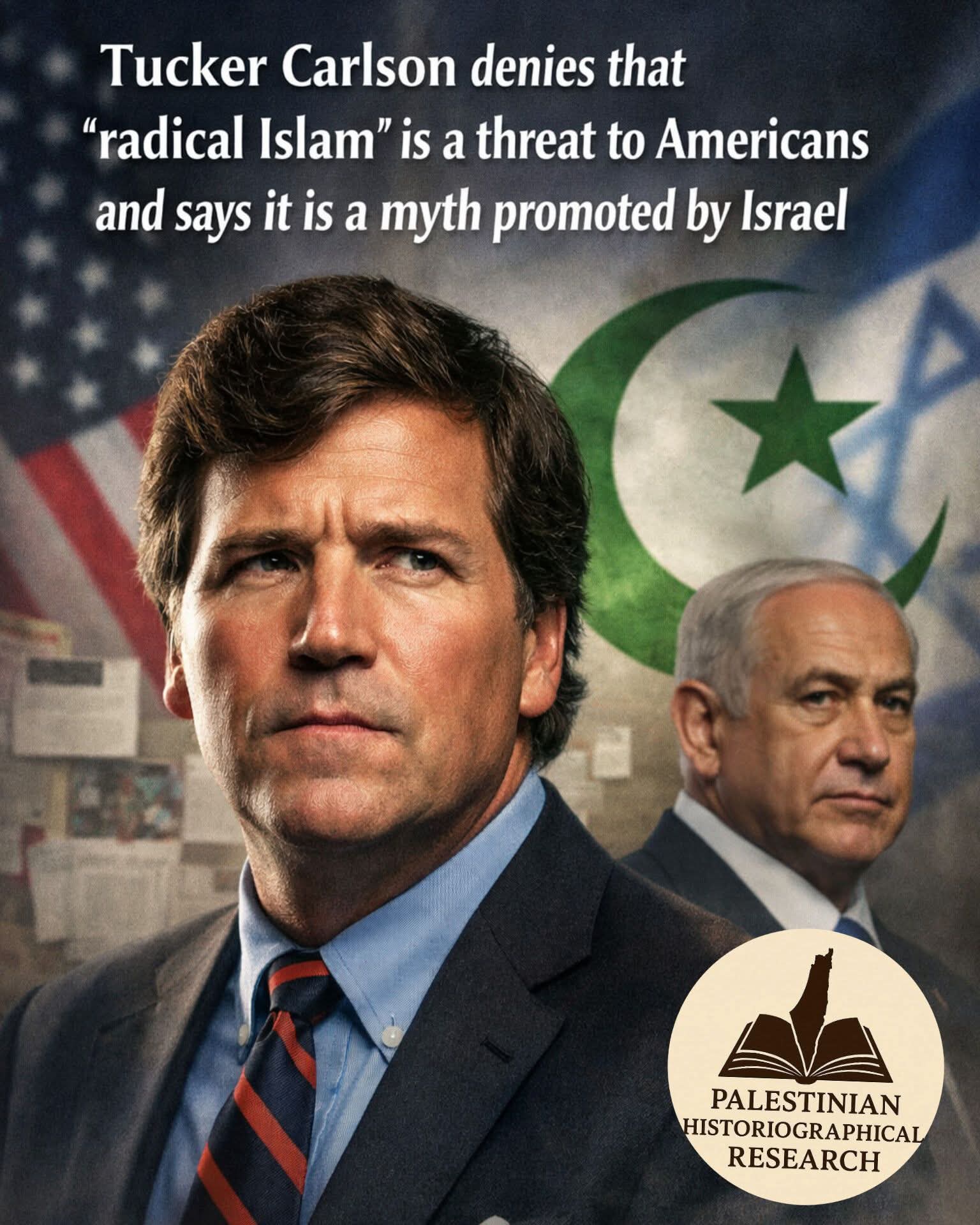
Who really defines the greatest threats facing the United States? In a recent interview with The American Conservative, published in late December 2025, political commentator Tucker Carlson surprised many by challenging the widespread belief that “radical Islam” represents the primary danger to Americans.
The remarks came in response to a survey conducted by Turning Point USA (TPUSA) during a conservative event, where attendees ranked “radical Islam” as the country’s biggest threat. Carlson pushed back strongly, stating: “I don’t know anyone in the United States in the last 24 years who has been murdered by radical Islam.” According to him, the fear has been “grossly inflated” and originates directly “from the Israeli government and its many defenders and informal employees in the United States.”
Carlson described this narrative as a propaganda operation—or “psyop”—designed to convince Americans that Israel’s enemies are automatically America’s enemies as well.
Watch the clip
In the viral clip, Carlson contrasts what he sees as an exaggerated external threat with issues that he believes are destroying lives across the United States every day. He pointed to the country’s drug addiction crisis—especially overdose deaths—and criticized the cultural impact of certain online platforms.
Among them, he singled out OnlyFans, claiming it is “turning a large percentage of American women into prostitutes.” He also cited video games, pornography, and the breakdown of family structures as factors contributing to social decline.
“I see millions of Americans being destroyed, and none of it is at the hands of radical Islam,” Carlson said. He even made a provocative comparison: “Is radical Islam more dangerous than OnlyFans? Not even close.”
The comments sparked strong reactions within conservative circles. Critics accused Carlson of downplaying real security threats or promoting conspiracy theories. In the same discussion, Carlson also questioned the U.S.–Israel alliance, describing it as a “liability” rather than a strategic benefit.
A broader debate
Carlson’s position fits into a broader international debate about Islamophobia and its role in political narratives, particularly in relation to Israel. Several Israeli right-wing leaders, including Prime Minister Benjamin Netanyahu and ultranationalist allies, have frequently used rhetoric that links political Islam—or groups such as Hamas—to inherent terrorism.
Such narratives are often used to justify strict security policies, the ongoing occupation, and military operations in Palestinian territories. International critics argue that some of these statements rely on sweeping generalizations about Muslims or Arabs as existential threats, which they interpret as a form of institutionalized Islamophobia aimed at maintaining both domestic support and international backing.
By calling the exaggeration of “radical Islam” a psyop, Carlson suggests that this narrative not only shapes American perceptions but also amplifies global fears toward Muslims in ways that align with geopolitical interests.
His remarks have been praised in some pro-Palestinian circles while criticized by others as an oversimplification that ignores historical terrorist attacks and real security risks.
Ultimately, Carlson argues that the United States should focus